 A B C D):
These manuscripts have simply been
studied too fully for there to be any hope of a complete examination here,
let alone complete bibliographies.
The sections below attempt no more than brief summaries.
A B C D):
These manuscripts have simply been
studied too fully for there to be any hope of a complete examination here,
let alone complete bibliographies.
The sections below attempt no more than brief summaries.
Note: In the catalog which follows, bold type indicates a full entry. Plain type indicates a short entry, which may occur under another manuscript.
Additional note regarding the Great Uncials (especially
A B C D):
These manuscripts have simply been
studied too fully for there to be any hope of a complete examination here,
let alone complete bibliographies.
The sections below attempt no more than brief summaries.
Contents:
* (01)
* A (02)
* B (03)
* C (04)
* Dea (05)
* Dp (06)
* Dabs
* Ee (07)
* Ea (08)
* Ep: see Dabs
* Fe (09)
* Fa
* Fp (010)
* Ge (011)
* Ga: see 095
* Gb: see 0120
* Gp (012)
* He (013)
* Ha (014)
* Hp (015)
* I (016)
* Ke (017)
* Kap (018)
* Le (019)
* Lap (020)
* Me (021)
* Mp: see 0121 and 0243
* N (022)
* Papr (025)
* Q (026)
* R (027)
* S (028)
* T (029)
* Tg (Scrivener Tp): see 061
* Tk (Scrivener Tg): see 085
* U (030)
* W (032)
* X (033)
* Z (035)
* G (Gamma, 036)
* D (Delta, 037)
* Q (Theta, 038)
* L (Lambda, 039)
*  (Xi, 040)
* P (Pi, 041)
* F (Phi, 043)
* Y (Psi, 044)
* 046
* 047
* 048
* 055
* 056
* 061
* 085
* 095 and 0123
* 0121 and 0243
* 0122
* 0123: see 095 and 0123
* 0212
* 0243: see 0121 and 0243 *
(Xi, 040)
* P (Pi, 041)
* F (Phi, 043)
* Y (Psi, 044)
* 046
* 047
* 048
* 055
* 056
* 061
* 085
* 095 and 0123
* 0121 and 0243
* 0122
* 0123: see 095 and 0123
* 0212
* 0243: see 0121 and 0243 *
(01)The entire New Testament portion, plus part of the Old and the non-Biblical books,
are in London, British Museum Add. 43725. A handful of Old Testament leaves are at
Leipzig. Originally found at Saint Catherine's Monastery on Mount Sinai, hence
the name "Codex Sinaiticus." A few stray leaves of the codex apparently remain at Sinai.
is the famous
Sinaiticus, the great discovery of Constantine von Tischendorf, the only surviving complete
copy of the New Testament written prior to the ninth century.
presumably originally contained the complete Greek Bible plus at least two
New Testament works now regarded as non-canonical: Barnabas and the Shepherd of Hermas.
As it stands now, we have the New Testament complete (all in London; 148 leaves
or 196 pages total), plus
Barnabas and Hermas (to Mandate iv.3.6). Of the Old Testament, we have about 250
leaves out of an original total of some 550. Apart from the portions still at Sinai
(which are too newly-found to have been included in most scholarly works), the Old
Testament portion consists of portions of Gen. 23, 24, Numbers 5-7 (these first portions
being cut-up fragments found in the bindings of other books), plus, more
or less complete, 1 Ch. 9:27-19:17, 2 Esdras (=Ezra+Nehemiah) 9:9-end, Esther,
Tobit, Judith, 1 Maccabees, 4 Maccabees (it appears that 2 and 3 Maccabees never formed
part of the text), Isaiah, Jeremiah, Lament. 1:1-2:20, Joel,
Obadiah, Jonah, Nahum, Habakkuk, Zephaniah, Haggai, Zechariah, Malachi, Psalms,
Proverbs, Ecclesiastes, Song of Songs, Wisdom of Solomon, Sirach, Job.
Dated paleographically to the fourth century. It can hardly be earlier, as the manuscript contains the Eusebian Canons from the first hand. But the simplicity of the writing style makes a later dating effectively impossible.
Tischendorf was of the opinion that four scribes wrote the manuscript; he labelled them A, B, C, and D. It is now agreed that Tischendorf was wrong. The astonishing thing about these scribes is how similar their writing styles were (they almost certainly were trained in the same school), making it difficult to distinguish them. Tischendorf's mistake is based on the format of the book: The poetic books of the Old Testament are written in a different format (in two columns rather than four), so he thought that they were written by scribe C. But in fact the difference is simply one of page layout; scribe C never existed. For consistency, though, the three remaining scribes are still identified by their Tischendorf letters, A, B, and D.
Of the three, scribe D was clearly the best, having almost faultless spelling. A, despite having a hand similar to D's, was a very poor scribe; the only good thing to be said about him was that he was better than B, whose incompetence is a source of almost continual astonishment to those who examine his work.
The New Testament is almost entirely the work of scribe A; B did not contribute at all, and D supplied only a very few leaves, scattered about. It is speculated (though it is no more than speculation) that these few leaves were "cancels" -- places where the original copies were so bad that it was easier to replace than correct them. (One of these cancels, interestingly, is the ending of Mark.)
It has been speculated that Sinaiticus was copied from dictation. This is because a number of its errors seem to be errors of hearing rather than of sight (including an amusing case in 1 Macc. 5:20, where the reader seems to have stumbled over the text and the copyist took it all down mechanically). Of course, the possibility cannot be absolutely ruled out that it was not Sinaiticus's exemplar, but one of its ancestors, which was taken down from dictation. In the case of the New Testament, at least, it seems likely that it was not taken from dictation but actually copied from another manuscript.
Sinaiticus is one of the most-corrected manuscripts of all time. Tischendorf counted 14,800 corrections in what was then the Saint Petersburg portion alone!
The correctors were numerous and varied. Tischendorf groups them into five sets, denoted a, b, c, d, e, but there were actually more than this. Milne and Skeat believe "a" and "b" to have been the original scribes (though others have dated them as late as the sixth century); their corrections were relatively few, but those of "a" in particular are considered to have nearly as much value as the original text.
The busiest correctors are those collectively described as "c," though in fact there were at least three of them, seemingly active in the seventh century. When they are distinguished, it is as "c.a," "c.b," and "c.pamph." Corrector c.a was the busiest of all, making thousands of changes throughout the volume. Many of these -- though by no means all -- were in the direction of the Byzantine text. The other two correctors did rather less; c.pamph seems to have worked on only two books (2 Esdras and Esther) -- but his corrections were against a copy said to have been corrected by Pamphilius working from the Hexapla. This, if true, is very interesting -- but colophons can be faked, or transmitted from copy to copy. And in any case, the corrections apply only to two books, neither in the New Testament. There may have been as many as two others among the "c" correctors; all told, Tischendorf at one time or another refers to correctors c, ca, cb, cc, and cc*.
Correctors d and e were much later (e is dated to the twelfth century), and neither added particularly many changes. Indeed, no work of d's is known in the New Testament.
It is unfortunate that the Nestle-Aland edition has completely befuddled this system
of corrections. In Nestle-Aland 26 and beyond,
a and
b are
combined as 1;
the correctors
c are
conflated as 2,
and (most confusing of all)
e
becomes c.
(For more information about the correctors of
,
see the article on Correctors.)
The history of Tischendorf's discovery of Codex Sinaiticus is told in nearly every introduction to New Testament criticism; I will not repeat it in any detail here (especially since there is a great deal of controversy about what he did). The essential elements are these: In 1844, Tischendorf visited Saint Catherine's Monastery on Mount Sinai. (Sadly, he did not do much to investigate the many fine minuscules at Mount Sinai, such as 1241 and 1881). At one point, he noted 43 sheets of very old parchment in a waste bin, destined to be burned. Tischendorf rescued these leaves (the Leipzig portion of Sinaiticus, all from the Old Testament), and learned that many more existed. He was not able to obtain these leaves, and saw no sign of the manuscript on a second visit in 1853.
It was not until 1859, near the end of a third visit, that Tischendorf was allowed to see the rest of the old manuscript (learning then for the first time that it contained the New Testament -- complete! -- as well as the Old). Under a complicated arrangement, Tischendorf was allowed to transcribe the manuscript, but did not have the time to examine it in full detail. Tischendorf wanted to take the manuscript to the west, where it could be examined more carefully.
It is at this point that the record becomes unclear. The monks, understandably,
had no great desire to give up the greatest treasure of their monastery. Tischendorf,
understandably, wanted to make the manuscript more accessible (though not necessarily
safer; unlike Saint Petersburg and London, Mount Sinai has not suffered a revolution
or been bombed since the discovery of
).
In hindsight, it seems quite clear that the monks were promised better terms than
they actually received (though this may be the fault of the Tsarist government rather
than Tischendorf). Still, by whatever means, the manuscript wound up in Saint
Petersburg, and later was sold to the British Museum.
There is at least one interesting sidelight on this, in that Tischendorf's story of his discovery has a clear historical precedent in the discovery of the Percy Manuscript. In around 1753, Thomas Percy was visiting his friend Humphrey Pitt when he discovered the maids burning a paper folio. (A much more reasonable thing to burn than a pile of parchments, which do not burn well!) Percy was able to rescue the century-old poetic miscellany, which eventually inspired him to publish his Reliques in 1765. [Source: Nick Groom, The Making of Percy's Reliques, Oxford, 1999, p. 6.] Happily, the parallels did not extend beyond that point: Percy edited, rewrote, and generally misrepresented his manuscript; Tischendorf published Sinaiticus with great precision.
However unfair these proceedings, they did make the Sinaiticus available to the world. Tischendorf published elaborate editions in the 1860s, Kirsopp Lake published a photographic edition before World War I, and once the manuscript arrived in the British Museum, it was subjected to detailed examination under ordinary and ultraviolet light.
The fact that is
both early and complete has made it the subject of intense textual scrutiny.
Tischendorf, who did not pay much attention to text-types, did not really analyse its text,
but gave it more weight than any other manuscript when preparing his eighth and
final critical edition. Westcott and Hort regarded it as, after B, the best and
most important manuscript in existence; the two made up the core of their
"neutral" text. Since then, nearly everyone has listed it as a primary
Alexandrian witness: Von Soden listed it as a member of the H type; the Alands
list it as Category I (which, in practice, means
purely Alexandrian); Wisse lists it as Group B in Luke; Richards classifies it as
A2 (i.e. a member of the main Alexandrian group) in the Johannine Epistles,
etc. The consensus was that there were only two places where the manuscript is not
Alexandrian: the first part of John, where it is conceded
that it belongs to some other text-type, probably "Western," (Gordon D. Fee,
in a study whose methodology
I consider dubious -- one can hardly divide things as closely as a single verse! -- puts
the dividing point at 8:38), and in the
Apocalypse, where Schmid classifies it in its own, non-Alexandrian, type with P47.
The truth appears somewhat more complicated. Zuntz, analysing 1 Corinthians
and Hebrews, came to the conclusion that
and B do not belong to the same text-type. (Zuntz's terminology is confusing,
as he refers to the P46/B type as "proto-Alexandrian,"
even though his analysis makes it clear that this is not the same type
as the mainstream Alexandrian text.) The true Alexandrian text of Paul, therefore,
is headed by , with
allies including A C I 33 81 1175. It also appears that the Bohairic Coptic tends toward
this group, although Zuntz classified it with P46/B (the Sahidic Coptic
clearly goes with P46/B), while 1739, which Zuntz places with P46/B,
appears to me to be separate from either.
This leads to the logical question of whether
and B actually belong together in the other parts of the Bible. They are everywhere
closer to each other than to the Byzantine text -- but that does not mean that they
belong to the same type, merely similar types. In Paul they are definitely separate. There
are hints of the same in the Gospels: B belongs to a group with P75, and this
group seems to be ancestral to L. Other witnesses, notably Z, cluster around
. While no one is
yet prepared to say that B and
belong to separate text-types in the gospels, the possibility must at least be admitted
that they belong to separate sub-text-types.
In Acts, I know of no studies which would incline to separate
and B, even within
the same text-type. On the other hand, I know of no studies which have examined the
question. It is likely that the two do both belong to the Alexandrian type, but whether
they belong to the same sub-type must be left unsettled.
In Paul, Zuntz's work seems unassailable. There is no question that B and
belong to different
types. The only questions are, what are those types, and what is their extent?
Zuntz's work is little help, but it would appear that the
-type
is the "true" Alexandrian text. P46 and B have only one
certain ally (the Sahidic Coptic) and two doubtful ones (the Bohairic Coptic, which
I believe against Zuntz to belong with ,
and the 1739 group, which I believe to be a separate text-type).
, however, has many
allies -- A, C, 33 ('s
closest relative except in Romans), and the fragmentary I are all almost pure examples
of this type. Very many minuscules support it with some degree of mixture; 81, 1175, and
1506 are perhaps the best, but most of the manuscripts that the Alands classify as
Category II or Category III
in Paul probably belong here (the possible exceptions are the members of
Families 365/2127,
330, and
2138). It is interesting to note that the
Alexandrian is the only non-Byzantine type with a long history -- there are no
P46/B manuscripts after the fourth century, and the "Western"
text has only three Greek witnesses, with the last dating from the ninth century,
but we have Alexandrian witnesses from the fourth century to the end of the manuscript
era. Apart from certain fragmentary papyri,
is the earliest and best of these.
The situation in the Catholic Epistles is complicated. The work of Richards on the
Johannine Epistles, and the studies of scholars such as Amphoux, have clearly revealed
that there are (at least) three distinct non-Byzantine groups here: Family 2138,
Family 1739 (which here seems to include C), and the large group headed by
P72, ,
A, B, 33, etc. Richards calls all three of these Alexandrian, but he has no
definition of text-types; it seems evident that Amphoux is right: These are
three text-types, not three groups within a single type.
Even within the Alexandrian group, we find distinctions. P72 and B
stand together. Almost all other Alexandrian witnesses fall into a group headed
by A and 33 (other members of this group include
Y, 81, 436).
stands alone;
it does not seem to have any close allies. It remains to be determined whether
this is textually significant or just a matter of defective copying (such things
are harder to test in a short corpus like the Catholic Epistles).
As already mentioned, Schmid analysed the manuscripts of the Apocalypse and
found that
stood almost alone; its only ally is P47. The other non-Byzantine
witnesses tend to cluster around A and C rather than
. The
general sense is that the A/C type is the Alexandrian text (if nothing else,
it is the largest of the non-Byzantine types, which is consistently true of the
Alexandrian text). Certainly the A/C type is regarded as the best; the
P47/
type is regarded as having many peculiar readings.
von Soden: d2
Many critical apparati (including those of Merk and Bover) refer to
using the
siglum "S."
Note: As with all the major uncials, no attempt is made to compile a complete bibliography.
Collations:
A full edition, with special type and intended to show the exact nature of the corrections, etc. was published by Tischendorf in 1861. This is now superseded by the photographic edition published by Kirsopp Lake (1911).
Sample Plates:
Images are found in nearly every book on NT criticism which contains pictures.
Editions which cite:
Cited in all editions since Tischendorf.
Other Works:
See especially H. J. M. Milne and T. C. Skeat, Scribes and Correctors of
Codex Sinaiticus (1938)
British Museum, Royal 1 D.v-viii. Volumes v, vi, and vii (as presently bound) contain the Old Testament, volume viii the New Testament. Originally given to the English by Cyril Lucar, at various times patriarch of Alexandria and Constantinople. He had it from Alexandria, and so the manuscript came to be called "Codex Alexandrinus," but it is by no means sure that it had always been there.
A originally contained the entire Old and New Testaments, plus I and II Clement and (if the table of contents is to be believed) the Psalms of Solomon. As the manuscript stands, small portions of the Old Testament have been lost, as have Matthew 1:1-25:6, John 6:50-8:52 (though the size and number of missing leaves implies that John 7:53-8:11 were not part of the manuscript), 2 Cor. 4:13-14:6. The final leaves of the manuscript have been lost, meaning that 2 Clement ends at 12:4. Like the New Testament, the Old contains some non-canonical or marginally canonical material: 3 and 4 Maccabees, Psalm 151, Odes.
There is some slight disagreement about the date of A. A colophon attributes it to Thecla, working in the time of Saint Paul (!), but this is clearly a later forgery. Although most experts believe the manuscript is of the fifth century, a few have held out for the late fourth. The number of scribes has also been disputed; Kenyon thought there were five, but Milne and Skeat (who had better tools for comparison) suggest that there are only two, possibly three. (The uncertainty lies in the fact that part of the New Testament, beginning with Luke and ending with 1 Cor. 10:8, present a rather different appearance from the rest of the New Testament -- but when compared in detail, the hand appears extremely similar to the scribe who did the rest of the New Testament.) Occasional letterforms are said to resemble Coptic letters, perhaps hinting at Egyptian origin, but this is not universally conceded.
A contains a significant number of corrections, both from the original scribe
and by later hands, but it has not undergone the sort of major overhaul we see in
or D or
even B (which was retraced by a later hand). Nor do the corrections appear to
belong to a particular type of text.
The story of how A reached its present location is much less involved than
that of its present neighbour .
A has been in England since 1627. It is first encountered in Constantinople
in 1624, though it is likely that Cyril Lucar (recently translated from
the Orthodox Patriarchate of Alexandria to that of Constantinople) brought it
with him from Egypt. Lucar was involved in a complex struggle with the Turkish
government, the Catholic church, and his own subordinates, and presented the
codex to the English in gratitude for their help. The Church of Constantinople
was disorderly enough that Lucar seems to have had some trouble keeping his hands
on the codex, but it eventually was handed over to the English.
After arriving in Britain, it did have one brief adventure: During the English Civil War, there was threat of dispersal of the Royal Library (the core of what became first the British Museum then the British Library). When Librarian Patrick Young was allowed to retire, he took the Alexandrinus with him; it was finally returned to the Library in 1664. Given how erratic was the behavior of Cromwell's followers, that may have been just as well.
A is somewhat confounding to both the friends and enemies of the Byzantine text, as it gives some evidence to the arguments of both sides.
A is Byzantine in the gospels; there can be no question of this. It is, in fact, the oldest Byzantine manuscript in Greek. (The Peshitta Syriac is older, and is Byzantine, but it obviously is not Greek.) But it is not a "normal" Byzantine witness -- that is, it is not directly related to the Kx type which eventually became dominant. The text of A in the Gospels is, in fact, related to Family P (Von Soden's Ik). Yet even those who documented this connection (Silva Lake and others) note that A is not a particularly pure member of Family P. Nor, in their opinions, was it an ancestor of Family P; rather, it was a slightly mixed descendent. The mixture seems to have been Alexandrian -- the obvious example being the omission of John 7:53-8:11, but A also omits, e.g., Luke 22:43-44 and (in the first hand) John 5:3. Westcott and Hort felt the combination of B and A to be strong and significant. We are nonetheless left with the question of the relationship between A and the rest of the Byzantine text. The best explanation appears to me to be that A is derived from a Byzantine text very poorly and sporadically corrected against an Alexandrian document (most likely not systematically corrected, but with occasional Byzantine readings eliminated as they were noticed in an environment where the Alexandrian text dominated). But other explanations are certainly possible.
The situation in the rest of the New Testament is simpler: A is Alexandrian
throughout. It is not quite as pure as
or B or the majority of the papyri; it has a few Byzantine readings. But the
basic text is as clearly Alexandrian as the gospels are Byzantine. The Alands,
for instance, list A as Category I in the
entire New Testament except for the Gospels (where they list it as
Category III for historical reasons). Von
Soden calls it H (but Ika
in the Gospels).
In Acts, there seems to be no reason to think A is to be associated particularly
with or
B. It seems to be somewhat closer to P74.
In Paul, the situation changes. A clearly belongs with
(and C 33
etc.) against P46 and B. This was first observed by Zuntz, and
has been confirmed by others since then.
The case in the Catholic Epistles is complicated. The vast majority
of the so-called Alexandrian witnesses seem to be weaker texts of a type
associated with A and 33. (Manuscripts such as
Y, 81, and 436 seem to
follow these two, with Byzantine mixture.) The complication is that neither
B nor
seems to be part of this type. The simplest explanation is that the
Alexandrian text breaks down into subtypes, but this has not been
proved.
In the Apocalypse, A and
once again part company. According to Schmid,
forms a small
group with P47, while A is the earliest and generally best of a much larger
group of witnesses including C, the vulgate, and most of the non-Byzantine minuscules.
In this book, the A/C text is considered much the best witness. Based on its number
of supporters relative to the
P47/
text, one must suspect the A/C text of being the mainstream Alexandrian text, but
this cannot really be considered proved -- there simply aren't enough early
patristic writings to classify the witnesses with certainty.
von Soden: d4
Note: As with all the major uncials, no attempt is made to compile a complete bibliography.
Collations:
The first publication of the manuscript was as footnotes to the London Polyglot. The symbol "A" comes from Wettstein. A photographic edition (at reduced size) was published by Kenyon starting in 1909.
Sample Plates:
Images are found in nearly every book on NT criticism which contains pictures.
Editions which cite:
Cited in all editions since Tischendorf (plus Wettstein, etc.)
Other Works:
Vatican Library, Greek 1209. The manuscript has been there for its entire known history; hence the title "Codex Vaticanus."
B originally contained the entire Old and New Testaments, except that it never included the books of Maccabees or the Prayer of Manasseh. The manuscript now has slight defects; in the Old Testament, it omits most of Genesis (to 46:28) and portions of Psalms (lacking Psalms 105-137). In the New Testament, it is defective from Hebrews 9:14 onward (ending KATA), omitting the end of Hebrews, 1 and 2 Timothy, Titus, Philemon, and the Apocalypse. It is possible that additional books might have been included at the end -- although it is also possible that the Apocalypse was not included. Indeed, it is barely possible (though this is rarely mentioned) that B originally omitted the Pastorals; this would accord with the contents of its relative P46.
It is universally conceded that B belongs to the fourth century, probably to the
early part of the century. It is in many ways very primitive, having very short
book titles and lacking the Eusebian apparatus. It has its own unique system of
chapter identifications; that in the gospels is found elsewhere only in
. It uses a continuous system of
numbers in Paul, showing that (in one or another of its ancestors), Hebrews
stood between Galatians and Ephesians, even though Hebrews stands after
Thessalonians in B itself. There is a second system in Paul as well; this doubling
of chapter enumerations, in fact, is found also in Acts and the Catholic Epistles,
save that 2 Peter is not numbered (perhaps because it was not considered canonical
by the unknown person who created this chapter system).
A single scribe seems to have been responsible for the New Testament, though two scribes worked on the Old. There were two primary correctors, though the dates of both are rather uncertain. The first is tentatively dated to the sixth century; the second comes from the tenth or eleventh. The second of these is much the more important, though more for damage done than for the actual readings supplied. This scribe, finding the manuscript somewhat faded, proceeded to re-ink the entire text (except for a few passages which he considered inauthentic). This scribe also added accents and breathings. This re-inking had several side effects, all of them (from our standpoint) bad. First, it defaced the appearance of the letters, making it much harder to do paleographic work. Second, it rendered some of the readings of the original text impossible to reconstruct. And third (though related to the preceding), it makes it very difficult to tell if there are any original accents, breathings, punctuation, etc. Such marks will generally disappear under the re-inking. Only when such a mark has not been re-inked can we be sure it came from the original hand.
It is not absolutely certain when B was damaged, but it certainly happened in the manuscript era, because a supplement with the missing material was later added to the volume. This supplement is late, in a minuscule hand (manuscript 1957, dated paleographically to the fifteenth century; it is believed that the Apocalypse was copied from a manuscript belonging to Cardinal Bessarion. It has been conjectured that Bessarion supplied the manuscript to the Vatican library, but this is pure conjecture; all that is known is that the manuscript has been in the library since the compiling of the first catalog in 1475.)
This is the manuscript. The big one. The key. It is believed that every non-Byzantine edition since Westcott and Hort has been closer to B than to any other manuscript. There is general consensus about the nature of its text: Westcott and Hort called it "Neutral" (i.e. Alexandrian); Von Soden listed it as H (Alexandrian), Wisse calls it Group B (Alexandrian), the Alands place it in Category I (which in practice also means Alexandrian). No other substantial witness is as clearly a member of this text-type; B very nearly defines the Alexandrian text.
Despite the unanimity of scholars, the situation is somewhat more complicated than is implied by the statement "B is Alexandrian." The facts change from corpus to corpus.
In the Gospels, Westcott and Hort centered the "Neutral"/Alexandrian
text around B and .
At that time, they agreed more closely with each other than with anything else
(except that Z had a special kinship with
). Since that
time, things have grown more complex. B has been shown to have a special affinity
with P75 -- an affinity much greater than its affinity with
, and of
a different kind. The scribal problems of P66 make it harder to
analyse (particularly since
departs the Alexandrian text in the early chapters of John), but it also
appears closer to B than .
Among later manuscripts, L has suffered much Byzantine mixture, but its
non-Byzantine readings stand closer to B than to
.
Thus it appears that we must split the Alexandrian text of the Gospels into,
at the very least, two subfamilies, a B family
(P66, P75, B, L, probably the Sahidic Coptic) and an
family (,
Z, at least some of the semi-Alexandrian minuscules). This is a matter
which probably deserves greater attention.
There is little to be said regarding Acts. B seems once again to be the purest
Alexandrian manuscript, but I know of no study yet published which fully details
the relations between the Alexandrian witnesses. It is likely that B, A, and
all belong
to the same text-type. We have not the data to say whether there are
sub-text-types of this text.
In Paul, the matter is certainly much more complex. Hort described B, in that
corpus, as being primarily Alexandrian but with "Western" elements.
This was accepted for a long time, but has two fundamental flaws. First, B has
many significant readings not found in either the Alexandrian
( A C 33 etc.)
or the "Western" (D F G latt) witnesses. Several good examples of this come from
Colossians: In 2:2, B (alone of Greek witnesses known to Hort; now supported by P46
and implicitly by the members of Family 1739) has
tou qeou Cristou; in 3:6, B (now supported
by P46) omits
epi tous uious ths apeiqeias.
Also, B was the earliest witness known to Hort; was it proper to define its text
in terms of two text-types (Byzantine and Alexandrian) which existed only in later
manuscripts?
It was not until 1946 that G. Zuntz examined this question directly; the results were published in 1953 as The Text of the Epistles: A Disquisition Upon the Corpus Paulinum. Zuntz's methods were excessively labourious, and cannot possibly be generalized to the entire tradition -- but he showed unquestionably that, first, B and P46 had a special kinship, and second, that these manuscripts were not part of the mainstream Alexandrian text. This was a major breakthrough in two respects: It marked the first attempt to distinguish the textual history of the Epistles from the textual history of the Gospels (even though there is no genuine reason to think they are similar), and it also marked the first attempt, in Paul, to break out of Griesbach's Alexandrian/Byzantine/Western model.
Zuntz called his proposed fourth text-type "proto-Alexandrian" (p. 156), and lists as its members P46 B 1739 (and its relatives; Zuntz was aware of 6 424** M/0121 1908; to this now add 0243 1881 630 2200) sa bo Clement Origen.
It appears to me that even this classification is too simple; there are five text-types in Paul -- not just the traditional Alexandrian, Byzantine, and "Western" texts, but two others which Zuntz combined as the "Proto-Alexandrian" text. (This confusion is largely the result of Zuntz's method; since he worked basically from P46, he observed the similarities of these manuscripts to P46 but did not really analyse the places where they differ.) The Alexandrian, "Western," and Byzantine texts remain as he found them. From the "Proto-Alexandrian" witnesses, however, we must deduct Family 1739, which appears to be its own type. Family 1739 does share a number of readings with P46 and B, but it also shares special readings with the Alexandrian and "Western" texts and has a handful of readings of its own. It also appears to me that the Bohairic Coptic, which Zuntz called Alexandrian, is actually closer to the true Alexandrian text.
This leaves B with only two full-fledged allies in Paul: P46 and the Sahidic Coptic. I also think that Zuntz's title "Proto-Alexandrian" is deceptive, since the P46/B type and the Alexandrian text clearly split before the time of P46. As a result, I prefer the neutral title P46/B type (if we ever find additional substantial witnesses, we may be able to come up with a better name).
When we turn to the Catholics, the situation seems once again to be simple. Most
observers have regarded B as, once again, the best of the Alexandrian witnesses --
so, e.g., Richards, who in the Johannine Epistles places it in the A2
group, which consists mostly of the Old Uncials:
A B C
Y 6.
There are several disturbing points about these results, though. First, Richards lumps together three groups as the "Alexandrian text." Broadly speaking, these groups may be described as Family 2138 (A1), the Old Uncials (A2), and Family 1739 (A3). And, no matter what one's opinion about Family 1739, no reasonable argument can make Family 2138 an Alexandrian group. What does this say about Richards's other groups?
Another oddity is the percentages of agreement. For the A2 group, Richards gives these figures for rates of agreement with the group profile (W. L. Richards, The Classification of the Greek Manuscripts of the Johannine Epistles, SBL Dissertation Series, 1977, p. 141):
| Manuscript | Agreement % |
| Y | 96% |
| C | 94% |
| 94% |
| B | 89% |
| A | 81% |
| 6 | 72% |
This is disturbing in a number of ways. First, what is 6 doing in the group?
It's far weaker than the rest of the manuscripts. Merely having a 70% agreement
is not enough -- not when the group profiles are in doubt!
Second, can Y, which has
clearly suffered Byzantine mixture, really be considered the leading witness
of the type? Third, can C (which was found by Amphoux to be associated with
Family 1739 in the Catholics) really be the leading Old Uncial of this type?
Fourth, it can be shown that most of the important Alexandrian minuscules (e.g.
33, 81, 436, none of which were examined by Richards) are closer to A than
to B or .
Ought not A be the defining manuscript of the type? Yet it agrees with the
profile only 81% of the time!
A much more reasonable approach is to take more of the Alexandrian minuscules
into account, and a rather different picture emerges. Rather than being the
weakest Alexandrian uncial, A becomes (in my researches) the earliest and key
witness of the true Alexandrian type, heading the group A
Y 33 81 436 al.
The clear majority of the Alexandrian witnesses in the Catholics go here, either
purely (as in the case, e.g., of 33) or with Byzantine mixture (as, e.g., in 436
and its near relative 1067). In this system, both B and
stand rather
off to the side -- perhaps part of the same type, but not direct ancestors of
anything. We might also note that B has a special kinship, at least in the Petrine
epistles, with P72, the one substantial papyrus of the Catholic Epistles.
Despite Richards, it appears that B and P72 form at least a sub-type of
the Alexandrian text.
von Soden: d1
Note: As with all the major uncials, no attempt is made to compile a complete bibliography.
Collations:
B has been published several times, including several recent photographic editions (the earliest from 1904-1907; full colour editions were published starting in 1968). It is important to note that the early editions are not reliable. Tischendorf, of course, listed the readings of the manuscript, but this was based on a most cursory examination; the Vatican authorities went to extraordinary lengths to keep him from examining Vaticanus. Others who wished to study it, such as Tregelles, were denied even the right to see it. The first edition to be based on actual complete examination of the manuscript was done by Cardinal Mai (4 volumes; a 1 volume edition came later) -- but this was one of the most incompetently executed editions of all time. Not only is the number of errors extraordinarily high, but no attention is paid to readings of the first hand versus correctors, and there is no detailed examination of the manuscript's characteristics. Despite its advantages, it is actually less reliable than Tischendorf, and of course far inferior to recent editions. Philipp Buttmann produced a New Testament edition based largely on B, but he had B's text via Mai, which he seemingly didn't trust very much, so the resulting edition isn't much like B or anything else (except 2427, which apparently was copied from it).
Sample Plates:
Images are found in nearly every book on NT criticism which contains pictures.
Editions which cite:
Cited in all editions since Tischendorf
Other Works:
The bibliography for B is too large and varied to be covered here. The reader
is particularly referred to a work already mentioned:
G Zuntz, The Text of the Epistles: A Disquisition Upon the Corpus Paulinum.
See also, e.g., S. Kubo, P72 and the Codex Vaticanus.
Paris, National Library Greek 9.
C originally contained the entire Old and New Testaments, but was erased in the twelfth century and overwritten with Syriac works of Ephraem. The first to more or less completely read the manuscript was Tischendorf, but it is likely that it will never be fully deciphered (for example, the first lines of every book were written in red or some other colour of ink, and have completely vanished). In addition, very many leaves were lost when the book was rewritten; while it is barely possible that some may yet be rediscovered, there is no serious hope of recovering the whole book.
As it now stands, C lacks the following New Testament verses in their entirety:
(and, of course, C may be illegible even on the pages which survive). We might note that we are fortunate to have even this much of the New Testament; we have significantly more than half of the NT, but much less than half of the Old Testament.
The original writing of C is dated paleographically to the fifth century, and is quite fine and clear (fortunately, given what has happened to the manuscript since). Before being erased, it was worked over by two significant correctors, C2 (Cb) and C3 (Cc). (The corrector C1 was the original corrector, but made very few changes. C1 is not once cited in NA27.) Corrector C2 is though to have worked in the sixth century or thereabouts; C3 performed his task around the ninth century. (For more information about the correctors of C, see the article on Correctors.)
It was probably in the twelfth century that the manuscript was erased and overwritten; the upper writing is a Greek translation of 38 Syriac sermons by Ephraem.
It is usually stated that C is a mixed manuscript, or an Alexandrian manuscript with much Byzantine mixture. The Alands, for instance, list it as Category II; given their classification scheme, that amounts to a statement that it is Alexandrian with Byzantine influence. Von Soden lists it among the H (Alexandrian) witnesses, but not as a leading witness of the type.
The actual situation is much more complex than that, as even the Alands' own figures reveal (they show a manuscript with a far higher percentage of Byzantine readings in the gospels than elsewhere). The above description is broadly accurate in the Gospels; it is not true at all elsewhere.
In the Gospels, the Alands' figures show a manuscript which is slightly more Byzantine than not, while Wisse lists C as mixed in his three chapters of Luke. But these are overall assessments; a detailed examination shows C to waver significantly in its adherence to the Alexandrian and Byzantine texts. While at no point entirely pure, it will in some sections be primarily Alexandrian, in others mostly Byzantine.
Gerben Kollenstaart brings to my attention the work of Mark R. Dunn in An Examination of the Textual Character of Codex Ephraemi Syri Rescriptus (C, 04) in the Four Gospels (unpublished Dissertation, Southwestern Baptist Theological Seminary 1990). Neither of us has seen this document, but we find the summary, "C is a weak Byzantine witness in Matthew, a weak Alexandrian in Mark, and a strong Alexandrian in John. In Luke C's textual relationships are unclear" (Summarized in Brooks, The New Testament Text of Gregory of Nyssa, p. 60, footnote 1). I dislike the terminology used, as it looks much too formulaic and appears to assume that C's textual affinities change precisely at the boundaries between books. (Given C's fragmentary state, this is even more unprovable than usual.) But the general conclusion seems fair enough: Matthew is the most Byzantine, John the least. In all cases, however, one suspects Byzantine and Alexandrian mixture -- probably of Byzantine readings atop an Alexandrian base. This would explain the larger number of Byzantine readings in Matthew: As is often the case, the corrector was most diligent at the beginning.
Outside the Gospels, C seems to show the same sort of shift shown by its near-contemporary, A -- though, because C possessed Alexandrian elements in the gospels, the shift is less noticeable. But it is not unfair to say that C is mixed in the Gospels and almost purely non-Byzantine elsewhere.
In short works such as Acts and the Catholic Epistles, the limited amount of text available makes precise determinations difficult. In the Acts, we can at least state definitively that C is less Byzantine than it is in the Gospels, but any conclusion beyond that is somewhat tentative. The usual statement is that C is Alexandrian, and I know of no counter-evidence. Nonetheless, given the situation in the Catholic Epistles, I believe this statement must be taken with caution.
The situation in the Catholic Epistles is purely and simply confused.
The published evaluations do not agree. W. L. Richards, in his dissertation
on the Johannine Epistles using the Claremont Profile Method,
does a fine job of muddling the issue. He lists C as a member of the A2
text, which appears to be the mainstream Alexandrian text (it also contains
, A, and B).
But something funny happens when one examines C's affinities. C has a 74% agreement
with A, and a 77% agreement with B, but also a 73% agreement with 1739, and a 72%
agreement with 1243. This is hardly a large enough difference to classify C
with the Alexandrians as against the members of Family 1739. And, indeed, Amphoux
and Outtier link C with Family 1739, considering their common material
possible "Cæsarean."
My personal results seem to split the difference. If one assumes C is Alexandrian, it can be made to look Alexandrian. But if one starts with no such assumptions, then it appears that C does incline toward Family 1739. It is not a pure member of the family, in the sense that (say) 323 is; 323, after all, may be suspected of being descended (with mixture) from 1739 itself. But C must be suspected of belonging to the type from which the later Family 1739 descended. (Presumably the surviving witnesses of Family 1739 are descended from a common ancestor more recent than C, i.e. Family 1739 is a sub-text-type of the broader C/1241/1739 type.) It is possible (perhaps even likely) that C has some Alexandrian mixture, but proving this (given the very limited amount of text available) will require a very detailed examination of C.
In Paul, the situation is simpler: C is a very good witness, of the
Alexandrian type as found in
A 33 81 1175 etc. (This as opposed to the type(s) found in P46
or B or 1739). So far as I know, this has never been disputed.
In the Apocalypse, C is linked with A in what is usually called the
Alexandrian text. No matter what it is called, this type (which also
includes the Vulgate and most of the better minuscules) is considered
the best type. Note that this is not the sort of text found
in P47 and .
von Soden: d3
Note: As with all the major uncials, no attempt is made to compile a complete bibliography.
Collations:
Various editors extracted occasional readings from the manuscript, but Tischendorf was the first to read C completely. Tischendorf is often reported to have used chemicals, but in fact it is believed that they were applied before his time -- and they have hastened the decay of the manuscript. Tischendorf, working by eye alone, naturally did a less than perfect job. Robert W. Lyon, in 1958-1959, published a series of corrections in New Testament Studies (v). But this, too, is reported to be imperfect. The best current source is the information published in the Das Neue Testament auf Papyrus series. But there is no single source which fully describes C.
Sample Plates:
Sir Frederick Kenyon & A. W. Adams, Our Bible and the Ancient Manuscripts
Editions which cite:
Cited in all editions since Tischendorf
Other Works:
Mark R. Dunn, An Examination of the Textual Character of Codex Ephraemi Syri Rescriptus (C, 04)
in the Four Gospels (unpublished Dissertation, Southwestern Baptist Theological
Seminary 1990)
Cambridge, University Library Nn. 2. 41. The well-known Codex Bezae, so-called because it was once the possession of Theodore Beza.
Greek/Latin diglot, with the Greek on the left page. The Greek currently contains the Gospels and Acts with lacunae; the manuscript lacks Matt. 1:1-20, 6:20-9:20, 27:2-12, John 1:16-3:26, Acts 8:29-10:14, 21:2-10, 16-18, 22:10-20, 29-end. In addition, Matt. 3:7-16, Mark 16:15-end, John 18:14-20:13 are supplements from a later hand. The Gospels are in the "Western" order Matthew, John, Luke, Mark, though Chapman offered evidence that an ancestor had the books in the order Matthew, Mark, John, Luke.
Since the Greek and Latin are on facing pages, the contents of the Latin side is not precisely parallel; d (the symbol for the Latin of D; Beuron #5) lacks Matt. 1:1-11, 2:20-3:7, 6:8-8:27, 26:65-27:2, Mark 16:6-20, John 1:1-3:16, 18:2-20:1, Acts 8:21-10:3, 20:32-21:1, 21:8-9, 22:3-9, 22:21-end. In addition, the Latin includes 3 John 11-15.
The original contents of D are somewhat controversial. Obviously it must have contained the Gospels, Acts, and 3 John. This would seem to imply that the manuscript originally contained the Gospels, Catholic Epistles, and Acts (in that order). This, however, does not fit well with the pagination of the manuscript; Chapman theorized that the manuscript actually originally contained the Gospels, Apocalypse, 1 John, 2 John, 3 John, and Acts (in that order).
The manuscript has been variously dated, generally from the fourth to the sixth centuries. In the middle of the twentieth century, the tendency seemed to be to date it to the sixth century; currently the consensus seems to be swinging back toward the fifth. It is very difficult to achieve certainty, however, as the handwriting is quite unique. The Greek and Latin are written in parallel sense lines, and the scribe uses a very similar hand for both languages -- so much so that a casual glance cannot tell the one language from the other; one must look at the actual letters and what they spell.
The unusual writing style is only one of the curiosities surrounding the scribe of D. It is not clear whether his native language was Greek or Latin; both sides of the manuscript contain many improbable errors. (Perhaps the easiest explanation is that the scribe's native language was something other than Greek or Latin.)
D's text, as will be discussed below, was far removed from the Byzantine standard (or, perhaps, from any other standard). As a result, it was corrected many times by many different scribes. Scrivener believed that no fewer than nine correctors worked on the manuscript, the first being nearly contemporary with the original scribe and the last working in the eleventh or twelfth century. In general, these correctors brought the manuscript closer to the Byzantine text (as well as adding occasional marginal comments and even what appear to be magical formulae at the bottom of the pages of Mark). For more recent views on these correctors, see D. C. Parker's work on Codex Bezae; Parker redates some of the correctors (moving them back some centuries), and believes that one had an Alexandrian text.
The text of D can only be described as mysterious. We don't have answers about it; we have questions. There is nothing like it in the rest of the New Testament tradition. It is, by far the earliest Greek manuscript to contain John 7:53-8:11 (though it has a form of the text quite different from that found in most Byzantine witnesses). It is the only Greek manuscript to contain (or rather, to omit) the so-called Western Non-Interpolations. In Luke 3, rather than the Lucan genealogy of Jesus, it has an inverted form of Matthew's genealogy (this is unique among Greek manuscripts). In Luke 6:5 it has a unique reading about a man working on the Sabbath. D and F are the only Greek manuscripts to insert a loose paraphrase of Luke 14:8-10 after Matt. 20:28. And the list could easily be multiplied; while these are among the most noteworthy of the manuscript's readings, it has a rich supply of other singular variants.
In the Acts, if anything, the manuscript is even more extreme than in the Gospels. F. G. Kenyon, in The Western Text of the Gospels and Acts, describes a comparison of the text of Westcott & Hort with that of A. C. Clark. The former is essentially the text of B, the latter approximates the text of D so far as it is extant. Kenyon lists the WH text of Acts at 18,401 words, that of Clark at 19,983 words; this makes Clark's text 8.6 percent longer -- and implies that, if D were complete, the Bezan text of Acts might well be 10% longer than the Alexandrian, and 7% to 8% longer than the Byzantine text.
This leaves us with two initial questions: What is this text, and how much authority does it have?
Nineteenth century scholars inclined to give the text great weight. Yes, D was unique, but in that era, with the number of known manuscripts relatively small, that objection must have seemed less important. D was made the core witness -- indeed, the key and only Greek witness -- of what was called the "Western" text.
More recently, Von Soden listed D as the first and chief witness of his Ia text; the other witnesses he includes in the type are generally those identified by Streeter as "Cæsarean" (Q 28 565 700 etc.) The Alands list it as Category IV -- a fascinating classification, as D is the only substantial witness of the type. Wisse listed it as a divergent manuscript of Group B -- but this says more about the Claremont Profile Method than about D; the CPM is designed to split Byzantine strands, and given a sufficiently non-Byzantine manuscript, it is helpless. (Biologists have a term for this phenomenon: It's known as "long branch assimiliation." If you have a large mass of closely related entities, and two entities not related to the large mass, the two distant entities may look related just because they are way out in the middle of nowhere.)
The problem is, Bezae remains unique among Greek witnesses. Yes,
there is a clear "Western" family in Paul (D F G 629 and
the Latin versions.) But this cannot be identified with certainty with
the Bezan text; there is no "missing link" to prove the
identity. Not one manuscript contains a "Western" text of both
the Gospels and Paul! There are Greek witnesses which have some kinship with
Bezae --
in the early chapters of John; the fragmentary papyri
P29 and P38 and P48 in Acts.
But none of these witnesses are complete, and none are as extreme
as Bezae.
D's closest kinship is with the Latin versions, but none of them are as extreme as it is. D is, for instance, the only manuscript to substitute Matthew's genealogy of Jesus for Luke's. On the face of it, this is not a "Western" reading; it is simply a Bezan reading.
Then there is the problem of D and d. The one witness to consistently agree with Dgreek is its Latin side, d. Like D, it uses Matthew's genealogy in Luke. It has all the "Western Non-Interpolations." And, perhaps most notably, it has a number of readings which appear to be assimilations to the Greek.
Yet so, too, does D seem to have assimilations to the Latin.
We are almost forced to the conclusion that D and d have, to some extent, been conformed to each other. The great question is, to what extent, and what did the respective Greek and Latin texts look like before this work was done?
On this point there can be no clear conclusion. Hort thought that D arose more or less naturally; while he considered its text bad, he was willing to allow it special value at some points where its text is shorter than the Alexandrian. (This is the whole point of the "Western Non-Interpolations.") More recently, however, Aland has argued that D is the result of deliberate editorial work. This is unquestionably true in at least one place: The genealogy of Jesus. Is it true elsewhere? This is the great question, and one for which there is still no answer.
As noted, Bezae's closest relatives are Latin witnesses. And these exist in abundance. If we assume that these correspond to an actual Greek text-type, then Bezae is clearly a witness to this type. And we do have evidence of a Greek type corresponding to the Latins, in Paul. The witnesses D F G indicate the existence of a "Western" type. So Bezae does seem to be a witness of an actual type, both in the Gospels (where its text is relatively conservative) and in the Acts (where it is far more extravagant). (This is in opposition to the Alands, who have tended to deny the existence of the "Western" text.)
So the final question is, is Bezae a proper witness to this text which underlies the Latin versions? Here it seems to me the correct answer is probably no. To this extent, the Alands are right. Bezae has too many singular readings, too many variants which are not found in a plurality of the Latin witnesses. It probably has been edited (at least in Luke and Acts; this is where the most extreme readings occur). If this is true (and it must be admitted that the question is still open), then it has important logical consequences: It means that the Greek text of Bezae (with all its assimilations to the Latin) is not reliable as a source of readings. If D has a reading not supported by another Greek witness, the possibility cannot be excluded that it is an assimilation to the Latin, or the result of editorial work.
von Soden: d5
Note: As with all the major uncials, no attempt is made to compile a complete bibliography.
Collations:
The standard reference is probably still F. H. A. Scrivener, Bezae Codex Canatabrigiensis, simply because of Scrivener's detailed and careful analysis. J. Rendel Harris published a photographic reproduction in 1899. See also J. H. Ropes, The Text of Acts and A. C. Clark, The Acts of the Apostles, both of which devote considerable attention to the text of Bezae in Acts.
Sample Plates:
(Sample plates in almost all manuals of NT criticism)
Editions which cite:
Cited in all editions since Tischendorf, and most prior to that.
Other Works:
The most useful work is probably James D. Yoder's Concordance to the
Distinctive Greek Text of Codex Bezae. There are dozens of specialized
studies of one or another aspect of the codex, though few firm conclusions
can be reached (perhaps the most significant is the conclusion of Holmes
and others that Bezae has been more thoroughly reworked in Luke than in
Matthew or Mark). See also the recent work by D. C. Parker, Codex
Bezae.
Paris, National Library Greek 107, 107 AB. The famous Codex Claromontanus (not to be confused with the even more famous, or infamous, Codex Bezae, also designated D) -- so-called because Beza reported that it had been found at Clermont.
Greek/Latin diglot, with the Greek and Latin in stichometric lines on facing pages. Contains the Pauline Epistles with the slightest of lacunae: It lacks Romans 1:1-7 (though we can gain some information about the readings of D in these verses from Dabs). In addition, Romans 1:27-30 and 1 Corinthians 14:13-22 are supplements from a later hand. (Scrivener, however, notes that this hand is still "very old.") Hebrews is placed after Philemon.
The Latin side, known as d (Beuron 75) has not been supplemented in the same way as the Greek; it lacks 1 Corinthians 14:9-17, Hebrews 13:22-end. Romans 1:24-27 are a supplement.
Scrivener observes that the very fine vellum actually renders the manuscript rather difficult to read, as the writing on the other side often shows through.
Almost all scholars have dated D to the sixth century (some specifying the second half of that century). The writing is simple, without accents or breathings; some of the uncial forms seem to be archaic. The Greek is more accurately written than the Latin; the scribe's first language was probably Greek. We should note certain broad classes of errors, however. The scribe very frequently confuses the verb ending -qe with -qai; this occurs so regularly that we can only say that D is not a witness at variants of this sort.
A total of nine correctors have been detected, though not all of these are important. The first important corrector (D** or, in NA26, D1) dates probably from the seventh century; the single most active corrector (D*** or D2, who added accents and breathings and made roughly 2000 changes in the text) worked in the ninth or tenth century; the final significant corrector (D*** or Dc) probably dates from the twelfth century or later.
There is an inherent tendency, because D is a Greek/Latin diglot and because it is called "D," to equate its text with the text of Codex Bezae, making them both "Western." This is, however, an unwarranted assumption; it must be proved rather than simply asserted.
There is at least one clear and fundamental difference between Bezae and Claromontanus: They have very different relationships to their parallel Latin texts. The Greek and Latin of Bezae have been harmonized; they are very nearly the same text. The same is not true of Claromontanus. It is true that D and d have similar sorts of text -- but they have not been entirely conformed to each other. The most likely explanation is that dp was translated from a Greek text similar to Dp, and the two simply placed side by side.
Claromontanus also differs from Bezae in that there are Greek manuscripts similar to the former: The close relatives F and G are also akin, more distantly, to Claromontanus. All three manuscripts, it should be noted, have parallel Latin versions (in the case of F, on a facing page; the Latin of G is an interlinear). All three, we might add, are related to the Old Latin codices (a, b, m; they are rather more distant from r) which do not have Greek parallels.
Thus it seems clear that there is a text-type centred about D F G and the Latins. Traditionally this type has been called "Western," and there is no particular reason to change this name.
We should make several points about this Western text of Paul, though. First, it is nowhere near as wild as the text of Codex Bezae, or even the more radical Old Latin witnesses to the Gospels and Acts. Second, it cannot be demonstrated that this is the same type as is found in Bezae. Oh, it is likely enough that Bezae's text is edited from raw materials of the same type as the ancestors of D F G of Paul. But we cannot prove this! Astonishingly enough, there is not one Old Latin witness containing both the Gospels and Paul. There are a few scraps (primarily t) linking the Acts and Paul, but even these are quite minimal. Thus, even if we assume that Bezae and Claromontanus represent the same type, we cannot really describe their relative fidelity to the type (though we can make a very good assumption that Claromontanus is the purer).
We should also examine the relations between the "Western" witnesses in Paul. It is sometimes stated that F and G are descendents of D. This almost certainly not true -- certainly it is functionally untrue; if F and G derive from D, there has been so much intervening mixture that they should be regarded as independent witnesses.
Interestingly, there is a sort of a stylistic difference between D and F/G. F and G appear to have, overall, more differences from the Alexandrian and Byzantine texts, but most of these are small, idiosyncratic readings which are probably the result of minor errors in their immediate exemplars. D has far fewer of these minor variants, but has an equal proportion (perhaps even a higher proportion) of more substantial variants.
So far we have mentioned only these two uncials as relatives of D. We should note that these manuscripts were merely the leading witnesses of Von Soden's Ia1 type; with them he classified a number of minuscules: 88 181 915 917 1836 1898 1912. Several of these minuscules (e.g. 88 and 181) do appear to be somewhat related to each other, but there is no real evidence that they are akin to the key "Western" witnesses. (88*, it is true, joins the Western uncials in placing 1 Corinthians 14:34-35 after 14:40, but this is nearly unique). The only minuscule to show real kinship with the Western uncials is 629. It is likely, however, that this kinship is not properly genetic; rather, 629 is a Greek/Vulgate diglot, and there are instances where the Greek seems to have been conformed to the Latin. Since the Vulgate, in Paul, has many "Western" readings, this has given 629 something of a "Western" tinge.
The case is rather different for the Latin witnesses. These clearly are related to D F G. The Latin d is closest to D, though by no means identical; b is also closely related. It is rather more distant from a and m, and still more distant from r (the latter fragments sometimes seem to approach the Alexandrian text). The other Old Latin fragments of Paul are too short to assess properly.
The classification used by the Alands for the diglot uncials of Paul is fascinating. None of them is classified as Category IV -- in other words, the Alands do not regard them a belonging to the same type as Codex Bezae. (Of course, it should be noted have not published definitions of their categories, but that it is clear that Category IV has no definition at all; they simply placed witnesses there because they felt like it.) But the situation is curious even if we ignore Category IV. In the second edition of their Introduction, they list D, the oldest manuscript of the type, as Category III; the same description is applied to G -- but F, which is universally agreed to be a close relative of G, but inferior on the whole, is listed as Category II! The most charitable word I can think of for this is "inexplicable."
von Soden: a1026
Note: As with all the major uncials, no attempt is made to compile a complete bibliography.
Collations:
Tischendorf's 1852 edition remains the standard (if it can be found); beyond that, one must turn to K. Junack, Das Neue Testament auf Papyrus, Vol. 2: Die paulinischen Briefe
Sample Plates:
Aland & Aland (1 plate); also a facsimile in Scrivener
Editions which cite:
Cited in all editions since Tischendorf, and most prior to that.
Other Works:
There are actually two manuscripts which circulate under the symbol Dabs, correctly designated Dabs1 and Dabs2. Both are Greek/Latin diglots. It is one of the curiosities of textual criticism that almost no manuscripts are known which are copies of other manuscripts. Only two uncials are known to be copies of other uncials -- and both are copies of the Pauline Codex D/06 (Claromontanus). Their descriptions are as follows:
Basel, University Library A.N. III. 12. Contains the Gospels almost complete; lacks Luke 3:4-15, 24:47-end. Luke 1:69-2:4, 12:58-13:12, 15:8-20 are supplements in a later, cursive hand. Dated paleographically to the eighth century (so all recent authorities; Burgon argued for the seventh; the letterforms look old, but the accents, breathings, and punctuation argue that it is relatively recent). This makes it the very first purely Byzantine uncial in any part of the Bible; it is the first Byzantine manuscript to contain not merely the small, more ordinary Byzantine readings but also the story of the Adulteress (found earlier in D, but no one will claim Bezae is Byzantine!). (In the gospels, there are earlier almost-pure Byzantine uncials: A and the Purple Uncials; elsewhere, all Greek witnesses to the Byzantine text are even later than E. Obviously the Byzantine type is much older than E. E is simply the earliest pure representative of what became the dominant type in the Middle Ages.) All examiners have agreed on E's Byzantine nature; the Alands list it as Category V; von Soden lists it as Ki; Wisse calls it Kx Cluster W. (We might add that Kx Cluster W is Ki; Wisse's three chapters did not provide enough text to distinguish the two groups, but historical evidence seems to imply that they are distinct although very closely related.) Certain disputed passages are marked with asterisks (Matt. 16:2-3, Luke 22:43-44, 23:34, John 8:2-11). It is well and carefully written, and probably deserves inclusion in critical apparati as the leading witness of the later Byzantine type.
Oxford, Bodleian Library, Laud. Greek 35. Called "Codex Laudianus"
because it was donated to the Bodleian Library by William Laud
(1573-1645 ),
the anti-Calvinist Archbishop of Canterbury under the British King Charles I.
),
the anti-Calvinist Archbishop of Canterbury under the British King Charles I.
Contains the Acts almost complete; lacks 26:29 (from paulos) to 28:26 (resuming after legon). The parchment is very thin, and there is some burn-through of ink, which, combined with the light colour of some letters, occasionally makes it difficult to read. Greek/Latin diglot, with the languages in parallel columns on the same page. The Latin is on the left. The manuscript is divided into sense lines of sorts, for purposes of parallelism, but as the lines are generally no more than fifteen letters long (often consisting of a single word!), they rarely form any real sort of syntactic unit.
Dated paleographically to the sixth or seventh century, with most scholars inclining toward the sixth. It can be demonstrated that it was in existence by no later than 716, since the Venerable Bede used it at that time for his commentary Expositio Retractata. (Giving us, incidentally, two Latin readings now lost: 27:5, 28:2). Prior to that, it had been in Sardinia; an entry (not by the original hand) refers to an edict of a Byzantine governor of that island (which was under Byzantine rule from 534).
It is hard to know what to make of the scribe. Although Metzger calls the uncials "clumsy," in fact both Greek and Latin letterforms are clearly written if large. On the other hand, the scribe had a great deal of difficulty with his pen, which ran dry every few letters. Based on this fact, it appears to me that he wrote the Latin column first, then the Greek, rather than writing across the page.
The Greek of E, it is generally conceded, is more Byzantine than anything else. The manuscript is mixed, however, there are many "Western" and some Alexandrian readings. (In fact, the manuscript seems somewhat block-mixed; "Western" readings are much more common in some sections than in others.) The Latin is not the vulgate, but rather a unique version of the Old Latin.
This raises the question of whether the Greek has been conformed to the Latin or vice-versa. Different scholars have answered this differently. Scrivener, for instance, reports that "the Latin... is made to correspond closely with the Greek, even in its interpolations and rarest various readings. The contrary supposition that the Greek portion of this codex Latinised, or has been altered to coincide with the Latin, is inconsistent with the facts of the case." More recent scholars such as Ropes and Clark, however, maintain that the Greek has in fact been conformed to the Latin. In this context, it is worth noting that the Latin is in the left-hand column, usually regarded as the place of honour.
It should be added, however, that the Latin of e seems somewhat unusual. And the arrangement of the two parts, with such short sense lines, argues that both texts may have undergone some adjustment. This is, however, only logic.... The most important point is that E has a mixed text, heavily but not purely Byzantine. It also has a number of interesting long readings, the most famous being Acts 8:37 (the Ethiopian Eunuch's acceptance of faith). By its nature, any reading in E must be taken with some hesitation and examination of its sources. This is reflected in earlier classifications of the manuscript: Von Soden listed it as Ia1 (i.e. as part of the core "Western" text), but the Alands list it as only Category II.
von Soden: a1001
Note: As with all the major uncials, no attempt is made to compile a complete bibliography.
Collations:
First published, with many inaccuracies, by Hearne in 1715 (Sabatier used this transcription in his Old Latin edition). Also collated by Tischendorf. Ropes and Clark also studied the manuscript in detail. Finally, if it can be found, there is a Ph.D. dissertation by O. Kenneth Walther, Codex Laudianus G 35: A Re-Examination of the Manuscript, Including a Reproduction of the Text and an Accompanying Commentary. The manuscript will also be published in the Acts volume of Das Neue Testament auf Papyrus.
Sample Plates:
Metzger, Manuscripts of the Greek Bible (1 page)
Metzger, The Text of the New Testament (1 page -- a smaller version of the above)
Sir Frederick Kenyon & A. W. Adams, Our Bible and the Ancient Manuscripts
(that same page again)
Editions which cite:
Cited in all editions since Tischendorf
Other Works:
Utrecht, University Library MS. 1. Contains the Gospels with significant lacunae, especially in Luke; the damage has been progressive, and some leaves have been lost since Wettstein saw it in 1730. (Between 1730 and 1830 it was in private hands, and was unbound, with the leaves becoming disordered and torn.) As it stands now, it begins with Matt. 9:1 (though in Wetstein's time it apparently started at 7:6); it also lacks Matt. 12:1-44, 13:55-14:9, 15:20-31, 20:18-21:5, (24:13-15 according to SQE but not Scrivener), Mark 1:43-2:8, 2:23-3:5, 11:6-26, 14:54-15:5, 15:39-16:19, John 3:5-14, 4:23-38, 5:18-38, 6:39-63, 7:28-8:10, 10:32-11:3, 12:14-25, 13:34-end. Luke is in even worse shape; Scrivener reports that there are 24 different lacunae, and SQE does not even bother collating the manuscript in that book. Dated paleographically to about the ninth century (so Tischendorf, von Soden, Aland; Tregelles preferred the tenth century). It has the Ammonian sections but not the Eusebian references; otherwise it has all the features of late uncials, including accents and breathings. The text is definitely Byzantine; the Alands list it as Category V; von Soden lists it as Ki. Wisse's classification doesn't mean much in this case; he lists F as Kmix in Luke 1, but it is defective for the other two chapters. In all likelihood it is actually either Kx or Ki (what Wisse would call Kx Cluster W). The date of the manuscript makes it potentially important for the history of the Byzantine text, but the large number of lacunae significantly reduce its value; it would have been much better had another Byzantine manuscript (preferably one of a type other than Kx) been used in the apparatus of SQE and UBS4.
This Symbol No Longer Used. This symbol was given by Wettstein to a manuscript of the Septuagint (M of sixth or seventh century) in which he found, in the original hand, a marginal text containing Acts 9:24-25. Uncials of the Acts were few enough that Wettstein included this as an uncial witness to Acts. Detailed examination later showed it to include several other New Testament passages. The complete list is: Matt. 5:48, 12:48, 27:25, Luke 1:42, 2:24, 23:21, John 5:35, 6:53, 55, Acts 4:33, 34, 9:24, 25, 10:13, 15, 22:22, 1 Cor. 7:39, 11:29, 2 Cor. 3:13, 9:7, 11:33, Gal. 4:21, 22, Col. 2:16, 17, Heb. 10:26. When Gregory regularized the catalog of uncials, however, he eliminated Fa on the grounds that it was not a continuous-text manuscript; it has not been cited since.
Cambridge, Trinity College B.XVII.1. Codex Augiensis, so-called because it comes from the monastery of Augia Dives in Lake Constance.
Greek/Latin diglot. The Greek lacks Romans 1:1-3:19, 1 Cor. 3:8-16, 6:7-14, Col. 2:1-8, Philem. 21-25, Hebrews. Save for the lacuna in Romans, all of these defects are supplied in the Latin. All the omissions save that in Romans are also paralleled in the sister manuscript Gp. The clear conclusion (also supported, e.g., by the pagination) is that both F and G were copied from a manuscript which omitted the passages in 1 Corinthians through Hebrews, but that the Romans passage (or most of it) was originally present in the manuscript and has now been lost. (Note: The general run of the Latin is not the Vulgate, but Hebrews does have a Vulgate text; in addition; NA26 lists the Latin sections not paralleled in the Greek as being supplements, but this seems to be based not on the nature of the writing but on its relationship with the Greek.)
The Greek and Latin are in parallel columns on the page, with the Greek in the inner column (closer to the spine of the book) and the Latin in the outer. Where the Greek fails, the Latin occupies the full width of the page.
Dated paleographically to the ninth century. Greek and Latin are both beautifully written, but the Greek quite incompetently; it is clear that the scribe was more comfortable in Latin (the most obvious example of this is word division: the exemplar clearly did not have word divisions, and while the scribe put in points to show divisions, they are very often in error. Another example is his handling of o and w; these vowels are often confused -- a trait I notice that I share as a user of the Roman alphabet). The scribe was almost certainly a native speaker of German.
The first and most obvious point about F is that it is an immediate relative of G, Codex Boernianus. The resemblances are both textual (they agree almost absolutely) and physical (they have the same lacunae).
It is generally conceded that G, although less attractive, has the better text. For this reason, many editions cite G and not F. This fact has also led to some rather absurd speculation -- notably that F is a copy of G. This is not the case. The two manuscripts are not direct descendents of one another; rather, they have a recent common ancestor. It is not impossible that they are sisters, both derived from a somewhat defective Greek/Latin diglot. Even this is by no means certain, however. It is worth noting that F and G, while they have nearly identical Greek texts, do not have identical Latin texts. The Latin of G (known as g) is a strict interlinear translation of the Greek. F, however, has a parallel Latin version, and this version is not the same as the Latin of G. Rather, the Latin of F (known as f) is a modified Vulgate. As the Latin version does not exactly match the Greek, it seems likely that it has been conformed to an Old Latin version.
It is worth noting that both G and F are written without heavy correction by the scribes. This strongly implies that both were copying texts that lay before them, rather than editing their Latin sides to match the Greek. In other words, there was probably (note the word probably; this is simply logic, and not assured!) an ancestor before the scribe of G with an interlinear Latin, and an ancestor before the scribe of F with a parallel Latin, including the lacunae in the Greek. Since the ancestor of F/G probably did not contain both an interlinear and a parallel Latin, there is presumably an intermediate manuscript in one or the other case. Continuing the logic, it appears more likely that G is copied directly from the common exemplar than that F is -- had the exemplar resembled F, it is likely that G's interlinear Latin would more nearly resembled f. Thus the highest likelihood is not that F and G are sisters, but that they are no closer than aunt and niece, and it is possible that they are merely cousins of some degree. (Thus the tendency to cite only G in the critical apparatus, ignoring F, is to be deplored; there may well be readings where F preserves the family text better than G, though it seems clear that G is overall the better and more complete witness. The only significant scholars to disagree with this assessment seem to be the Alands, who -- in what can only be labelled an inexplicable classification -- list F as Category II, but G, and D for that matter, as Category III.)
The relationship with Codex Claromontanus (D) has also been a matter of discussion. I have seen stemma implying that F and G are descended from D, and others implying a common ancestor which was the parent of D. This is quite absurd; there are simply too many major differences between the three (perhaps the best single example of this is the ending of Romans: D includes 16:25-27 at the end of that book, but F and G omit altogether). No one will deny that these three manuscripts form a text-type, but they are by no means immediate kin.
For the relationship between the "Western" text of Paul (the usual name given to the text of D F G and the Latin versions) to the "Western" text of Codex Bezae, see the entry on that manuscript and the entry on Codex Claromontanus.
von Soden: a1029
Note: As with all the major uncials, no attempt is made to compile a complete bibliography.
Collations:
The basic work remains F. H. A. Scrivener, An Exact Transcript of Codex Augiensis. One may check this against the Pauline portion of Das Neue Testament auf Papyrus.
Sample Plates:
Editions which cite:
Because of its close similarity to G, most editions cite F only intermittently.
The primary exceptions are Tischendorf and NA26 and NA27
Other Works:
London, British Museum Harley 5684 (a single leaf, taken from the codex by J. C. Wolff and given to Bentley, is in Cambridge, Trinity College B.XVII.20; it contains Matt. 5:29-31, 39-43). Called codex Wolfii A after the first important owner (though the manuscript in fact originated in the east, and was brought to the west by Andrew Erasmus Seidel), or alternately Codex Harleianus after its present location. Contains the Gospels with lacunae; lacks Matt. 1:1-6:6 (a small part of this, be it noted, being included on the Cambridge leaf), 7:25-8:9, 8:23-9:2, 28:18-Mark 1:13, Mark 14:19-25, Luke 1:1-13, 5:4-7:3, 8:46-9:5, 12:27-41, 24:41-end, John 18:5-19, 19:4-27. Portions of this damage were rectified by later hands: One scribe supplied Matt. 28:18-Mark 1:8 and John 18:5-19, another Luke 12:27-41. Earlier editors, such as Scrivener, dated the manuscript to the tenth century, but the Alands have lowered this to the ninth century. (Part of the problem may be the scribe's coarse writing, small uncials drawn with a pen much too large for the chosen size; Scrivener gives a facsimile showing irregular accents and breathings and demonstrating the ugly writing style.) There is more agreement about the text; all would agree that it is Byzantine. Von Soden classified it as Ki, and the Alands list it as Category V; Wisse describes it as Kx. There are hints of something more, though; even the Alands' figures show G as having a relatively high number of non-Byzantine, non-UBS readings (a total of 21, out of 288 readings tested; by way of comparison, E has 9 such "s" readings out of 326 readings examing, H has 7 in 265 test readings; M has 12 in 327; S has 12 in 327). It may be simply that the manuscript is carelessly written, but in working through the apparatus of SQE, I was struck by how many of the non-Byzantine readings seemed to be "Cæsarean." Great care, of course, must be taken in dealing with the "Cæsarean" text, as its very existence is questionable and the text has never been properly defined -- but this pattern of readings may imply that the handful of non-Byzantine readings, few though they are, are not errors and may have some slight value. (I repeat, however, that this is based solely on my subjective examination of the SQE critical apparatus; the matter needs to be examined in detail before this is taken as fact.)
Dresden, Sächsiche Landesbibliothek A 145b. Codex Boernerianus, so-called because it was formerly owned by C. F. Börner of Leipzig.
Greek/Latin interlinear diglot, lacking Romans 1:1-4, 2:17-24, 1 Cor. 3:8-16, 6:7-14, Col. 2:1-8, Philem. 21-25, Hebrews. These defects were clearly present in the exemplar as well, as all are shared by Fp, which was derived from the same exemplar.
It has been argued that G and the gospel manuscript D were originally part of the same volume; they are are similarly written, both are interlinear diglots, and the pages are exactly the same size. We should note, though, that not all commentators are convinced by these arguments. There is at least one counter-argument, though it is textual rather than physical or paleographic: The text of D is Byzantine, with Alexandrian elements in Mark; the text of G is purely and simply "Western." And while there are genuine physical similarities between the manuscripts (probably because they both derive from Saint Gall), D appears rather finer and fancier (though this may simply be because the Gospels are usually given finer treatment).
Dated paleographically to the ninth century by all authorities. The manuscript is written without accents or breathings, but with spaces between words (sometimes misplaced), in a stiff, awkward hand; the letterforms do not much resemble other manuscripts of the period (save D; while the two may not be part of the same volume, they are almost certainly from the same school as they resemble each other even in small details of preparation). The latin interlinear is written above the Greek, with the Greek lettering fairly large and the Latin extremely small. There is some slight decoration in colour, though not nearly as much as in D. A dot and an enlarged letter marks the beginning of phrases. It has been theorized (probably correctly) that the exemplar of G was written in some sort of sense lines, as the separate phrases and enlarged letters are almost evenly spaced.
A peculiar fact about the manuscript is that it contains (on folio 23) some verses in (archaic) Irish Gaelic referring to a pilgrimage to Rome. The writing in these verses appears similar to that of the Latin; the original scribe may have been Irish (many Irish monks settled in Saint Gall). But this point has not, as far as I know, been proved.
Another fact is that the scribe doesn't seem to have been accustomed to the type of text he copied. G (along with F and 629) omits Romans 16:25-27 -- but the scribe of G left room for the verses after 14:23. There is no sign of this in F; the simplest explanation (though by no means sure!) is that the scribe of G was more accustomed to a text containing those verses there.
In the entry on Fp, we noted the similarities between F and G. Not only are they both Greek/Latin diglots, but they have the same lacunae (with the exception of the first part of Romans, where F is defective). The similarity is further confirmed by their texts. Scrivener, who collated both, lists 1,982 differences -- but breaks them down as 578 blunders of the scribe, 967 vowel changes (including itacisms), 166 instances of interchanged consonants, and 71 grammatical or orthographic differences, 32 instances of addition or omission of the article, and 168 instances of clear variants.
Like F, the word division is sometimes peculiar, implying that the two were copied from an exemplar without word divisions. The two do not use identical word divisions, however, meaning that they can hardly have been copied from one another. That neither is a copy of the other is confirmed by much additional evidence. The key fact, perhaps, is that the two are in completely different styles: F has a facing Latin text, G an interlinear, but both are copied without major corrections by the scribes, implying that both Greek and Latin texts were present in their current forms in the exemplars. Nor do the Latin versions match closely.
Of the two, G seems to be the more accurate overall (despite the much uglier writing). One often finds G cited to the exclusion of F. This is unfortunate, since both are needed to reconstruct the exemplar, but certainly G is the one to choose if only one is to be cited.
That F and G belong to the same text-type as Dp and the Old Latin versions need not be doubted. This type is generally called "Western," though no absolutely convincing proof has been offered that this is truly the same type as found in Codex Bezae in the gospels. The relationship between D, F, and G is somewhat involved; while F and G are cousins or closer (see the discussion in the entry on F), D is much more distant -- not really kin at all, except at the text-type level. (Some manuals show D as an uncle, or even a direct ancestor, of F and G, but this is extremely unlikely -- there are too many differences; consider, for instance, their various forms of the ending of Romans.) Examination seems to show that F and G have more minor divergences from the common Alexandrian and Byzantine text than D (indeed, F and G may be the most idiosyncratic of all manuscripts in this regard, adding, changing, and omitting articles, pronouns, and other secondary words almost at random). They may actually have fewer large variants than D, however (this position was first stated by Corssen in 1889; I came to the conclusion independently). Casual inspection also seems to imply that F and G fall slightly closer to P46 and B than does D.
The Latin side of G, known as g (Beuron 77), is less interesting than the Greek. As an interlinear, it has been heavily conformed to the Greek, though there probably was an independent Latin version behind it (and used as a crib). An interesting feature of g is that it sometimes has alternate rendering. Metzger cites an example from 1 Corinthians 3:2; the Greek text reads gala umas epoteisa (NA26 gala umas epotisa). The alternate readings are for umas, where g reads vos vel vobis. It is at least possible that some of these alternate readings are places where the Latin reference edition used to compile g disagreed with the Greek text of G (particularly as there are instances where g does not match G at all).
Most classifications of G, of course, have closely followed the classification of F -- Von Soden, e.g., lists both as Ia1, in the same group as D (and, we must note, some unrelated minuscules). The one curiosity is the Alands, who place G in Category III but F in Category II. (For further discussion, see the entry on Fp).
von Soden: a1028
Note: As with all the major uncials, no attempt is made to compile a complete bibliography.
Collations:
First published by Matthei, in an edition said to be highly accurate but,
of course, now nearly inaccessible. Scrivener published a detailed collation
against F in F. H. A. Scrivener, An Exact Transcript of
Codex Augiensis. One may check this against the Pauline portion of
Das Neue Testament auf Papyrus.
Sample Plates:
Metzger, Manuscripts of the Greek Bible (1 plate)
Aland & Aland, The Text of the New Testament (1 plate)
Editions which cite:
Cited in all editions since Tischendorf, and some before.
Other Works:
Primarily at Hamburg, University Library, Cod. 91 in scrin.; one folio (formerly in the possession of Bentley, who never returned it to its rightful owner) is in Cambridge, Trinity College Library B.XVII.20. Called Codex Seidelianus II (after the man who brought it from the east) or Wolfii B after the first important owner. Contains the Gospels with major lacunae; lacks Matt. 1:1-15:30, 25:33-26:3, Mark 1:32-2:4, 15:44-16:14, Luke 5:18-32, 6:8-22, 10:2-19, John 9:30-10:25, 18:2-18, 20:12-25. It may never have been fully finished; it contains the Ammonian sections but not the Eusebian canons. Dated by all authorities to the ninth century. The text is definitely Byzantine -- though Scrivener reports that some esteemed H as having somewhat greater value than G, meaning probably that it was a little less Byzanine. This does not seem to be born out by the evidence; the Alands, naturally, list H as Category V, but also show it with a very low number of non-Byzantine readings (only 9 readings in either Category 2 or Category S; G, by contrast, has 25). My own informal experience bears this out; H has very few non-Byzantine readings. Wisse describes H as Kx. Von Soden (who designated it as e88) listed it as Ki, a group which Wisse considers part of Kx.
Modena, Biblioteca Estense, G.196 (II.G.3), folios 9-51 (the remaining folios, which contain the Catholic and Pauline Epistles, are now designated 2125). Codex Mutinensis. The uncial portion contains Acts only, and is defective for Acts 1:1-5:28, 9:39-10:19, 13:36-14:3, 27:4-28:31. The first three lacunae have been supplied in a minsucule hand (formerly designated h), the last by an uncial hand. Overall, the manuscript is dated to the ninth century, and Burgon thought the minuscule supplements to be "scarcely later," while the uncial supplement containing 27:4-28:31 has been dated to the eleventh century. The additional material found in 2125 was dated to the twelfth century by Scrivener, but the Alands give a tenth century date. There is little to be said about the text, save that it is Byzantine; the Alands list H as Category V, while Von Soden (who gave the manuscript the symbol a6) lists it as K with some I influence.
41 folios distributed among eight numbers in seven libraries in six cities: 8 leaves at the Great Lavra on Mount Athos; 3 leaves in Kiev (Nat.-Bibl. Petrov 26); 3 leaves in St. Petersburg (Bibl. Gr. 14); 3 leaves in Moscow (Hist. Mus. 563 and Ross. Gosud. Bibl. Gr. 166,1); 22 leaves in Paris (Bibl. Nat. Suppl. Gr. 1074 and Bibl. Nat. Coislin 202; the latter number also describing 94); 2 leaves at Turin (Bibl. Naz. A.1). Collectively known as Codex Coislinianus.
H presumably originally contained the entire Pauline corpus. At some point it was disassembled and the leaves used to bind other books (the Athos leaves were placed in the binding of a book dated 1218 by a monk named Makarius). The surviving leaves contain 1 Cor. 10:22-29, 11:9-16; 2 Cor. 4:2-7, 10:5-11:8, 11:12-12:4; Gal. 1:1-10, 2:9-17, 4:30-5:5; Col. 1:26-2:8, 2:20-3:11; 1 Thes. 2:9-13, 4:5-11; 1 Tim. 1:7-2:13, 3:7-13, 6:9-13; 2 Tim. 2:1-9; Titus 1:1-3, 1:15-2:5, 3:13-15; Hebrews 1:3-8, 2:11-16, 3:13-18, 4:12-15, 10:1-7, 10:32-38, 12:10-15, 13:24-25.
Dated paleographically to the sixth century. H is written on parchment in extremely large uncials (over 1.5 cm in height), one column per page. The text is written stichometrically. A later hand added accents and breathings to the text although not to the subscriptions of the books.
Aland and Aland list H as Category III; von Soden classifies it among the Alexandrian witnesses. From the stichometric arrangement of the lines, as well as the subscriptions to the various books (written in vermillion), H would appear to be based on the Euthalian edition of Paul -- probably the earliest example of this type.
A footnote to Titus claims that the text was corrected based on a manuscript written by Pamphilius. This is either an error or refers to the exemplar used for H; such corrections as we find in the text are almost always Byzantine (see the entry on correctors).
Overall, the text of H does appear to be Alexandrian, but with much Byzantine mixture. It is probably of more note for the history of the Euthalian text than the biblical text as a whole.
von Soden: a1022
Collations:
Sample Plates:
Editions which cite:
Cited in all editions since Tischendorf.
Other Works:
M. H. Omont, Notice sur un très ancien manuscrit grec
en onciales des Epîtres de Paul, conservé à la
Bibliothèque Nationale, 1889 (a partial edition, based on
materials available at the time).
Washington, Freer Gallery of Art, 06.275. Called Codex Freerianus or
Codex Washingtonensis. Contains fragments of the Pauline Epistles (84
folios). The extant fragments consists of (portions of)
1 Cor. 10:29, 11:9-10, 18-19,
26-27, 12:3-4, 27-28,
14:12-13, 22, 32-33, 15:3,
15, 27-28, 38-39, 59-50,
16:1-2, 12-13; 2 Cor. 1:1,
9, 16-17, 2:3-4, 14,
3:6-7, 16-17, 4:6-7,
16-17, 5:8-10, 17-18,
6:6-8, 16-18, 7:7-8,
13-14, 8:6-7, 14-17,
8:24-9:1, 9:7-8,
9:15-10:1, 10:8-10,
10:17-11:2, 11:9-10, 20-21,
28-29, 12:6-7, 14-15,
13:1-2, 10-11; Gal. 1:1-3,
11-13, 1:22-2:1, 2:8-9,
16-17, 3:6-8, 16-17,
24-28, 4:8-10, 20-23; Eph.
2:15-18, 3:6-8, 18-20,
4:9-11, 17-19, 28-30,
5:6-11, 20-24, 5:32-6:1,
6:10-12, 19-21; Phil. 1:1-4,
11-13, 20-23, 2:1-3,
12-14, 25-27, 3:4-6,
14-17, 4:3-6, 13-15; Col.
1:1-4, 10-12, 20-22,
27-29, 2:7-9, 16-19,
3:5-8, 15-17, 3:25-4:2,
4:11-13; 1 Thes. 1:1-2, 9-10,
2:7-9, 14-16, 3:2-5,
11-13, 4:7-10, 4:16-5:1,
5:9-12, 23-27; 2 Thes. 1:1-3,
10-11, 2:5-8, 14-17, 3:8-10;
1 Tim. 1:1-3, 10-13,
1:19-2:1, 2:9-13, 3:7-9,
4:1-3, 10-13, 5:5-9,
16-19, 6:1-2, 9-11,
17-19; 2 Tim. 1:1-3, 10-12,
2:2-5, 14-16, 22-24,
3:6-8, 3:16-4:1, 4:8-10,
18-20; Tit. 1:1-3, 10-11,
2:4-6, 14-15, 3:8-9; Philem.
1-3, 14-16; Heb. 1:1-3,
9-12, 2:4-7, 12-14,
3:4-6, 14-16, 4:3-6,
12-14, 5:5-7, 6:1-3,
10-13, 6:20-7:2, 7:7-11,
18-20, 7:27-8:1, 8:7-9,
9:1-4, 9-11, 16-19,
25-27, 10:5-8, 16-18,
26-29, 35-38, 11:6-7,
12-15, 22-24, 31-33,
11:38-12:1, 12:7-9, 16-18,
25-27, 13:7-9, 16-18,
23-25.
These represent 84 leaves (many fragmentary) out of an original total
of about 210; Hebrews followed 2 Thessalonians. The manuscript is generally
dated to the fifth century, though a few have suggested the sixth century
instead. There is little doubt about the text; it is clearly
Alexandrian. Von Soden (who designated it as
a1041) lists it
as type H, while the Alands place it in Category II,
ascribing it to the Egyptian text. Their own numbers, however, make this
dubious; of the 34 readings of I, only one is purely Byzantine, while 22
agree with UBS against the Byzantine text; six agree with neither. While this
is too small a sample to allow for absolute certainty, on its face it implies
that I is not Category II but Category I, and Alexandrian, not a member of
the later Egyptian text. By the numbers, I is the most Alexandrian manuscript
of Paul! And my own checking indicates that I is the closest relative
of in
existence (and much closer to A C 33 than it is to P46 or B or
1739). Its fragmentary nature limits its usefulness, but where it exists,
I deserves to be treated with all the respect accorded to
or A.
Paris -- Bibliothèque Nationale Gr. 63. It was taken to Paris from Cyprus in 1673.
Contains the Gospels complete.
Dated paleographically to the ninth century. K is written on parchment, one column per page. The scribe was named Basil, and the manuscript was bound by one Theodulos. Scrivener says of the writing, "[It has] one column of about twenty-one lines per page, but the handwriting is irregular and varies much in size. A single point being often found where sense does not require it, this codex has been thought to have been copied from an older one arranged in sticoi.... The subscriptions, titloi, the sections, and indices of the kefalia of the last three gospels are believed to be the work of a later hand: the Eusebian canons are absent. The breathings and accents are primâ manu, but are often omitted or incorrectly placed. Itacisms and permutations of consonants are very frequent...."
Recognized from a very early date as Byzantine (so, e.g., Aland and Aland, who list it as Category V). Von Soden classified it as Ika, i.e. Family P. This has been confirmed by all who have investigated the matter, most recently by Wisse (who places K in the Pa group in all three tested chapters of Luke, and calls it a core member of the group).
Wisse distinguishes two groups within Family P -- Pa and Pb. Of these, Pa is more distinct and has more differences from the Byzantine bulk Kx. Among the more important members of this group are K itself, P, 1079, and 1546. A (which is, of course, the earliest substantial Byzantine witness) is a diverging member of this group. The case can thus be made that K belongs to the oldest family of the Byzantine text -- and it is the oldest complete witness to this text.
von Soden: e71
Collations:
Sample Plates:
Editions which cite:
Cited by Tischendorf (who also collated it).
Cited by von Soden, Merk, and Bover.
Cited as a secondary witness in NA26 and NA27,
but not in SQE13
Cited in UBS3 but not UBS4
Other Works:
All of the following pertain to Family P,
and so include information on K as well (although the works of Geerlings are sometimes
guilty of dubious methodology):
Jacob Geerlings, Family P
in John, Studies & Documents 23, 1963
Jacob Geerlings, Family P
in Luke, Studies & Documents 22, 1962
Jacob Geerlings, Family P
in Matthew, Studies & Documents 24, 1964
Silva Lake, Family P
and the Codex Alexandrinus: The Text According to Mark, Studies & Documents 5, 1937
Moscow -- Historical Museum V.93, S.97. Originally from Mount Athos.
Contains the Catholic Epistles complete and Paul almost complete (lacks Romans 10:18-1 Corinthians 6:13; 1 Corinthians 8:8-11). Includes a marginal commentary.
Dated paleographically to the ninth century. K is written on parchment, two columns per page.
Von Soden classifies K as I1 in Paul and Apr1 in the Catholics. This is based, however, on the commentary (being that of John of Damascus in Paul and, according to von Soden, that of Andreas in the Catholics). The text is correctly described by Aland and Aland as Category V (i.e. purely Byzantine).
Within the Byzantine tradition, K forms a pair with 0151. The two may be sisters; certainly they are very closely related. Taking the book of Galatians as an example, we find 279 variants which can count at least two papyri or uncials on each side. K and 0151 agree on 263 of these. (In addition, K has seven singular readings and 0151 has ten.) Of these 263 agreements, seven are found only in these two manuscripts (a very high rate of subsingular agreement for Byzantine manuscripts).
Even their sixteen disagreements are suggestive:
| Verse | K reads | 0151 reads |
| 1:22 | ths | tais |
| 2:4 | katadoulwswntai | katadoulwsontai |
| 3:8 | soi | su |
| 3:19 | w | o |
| 3:22 | - | ta |
| 4:4 | gennomenon ek | genomenon ek vid |
| 4:6 | krazwn | krazon |
| 4:7 | alla | all |
| 5:14 | seauton | eauton |
| 5:26a | ginomeqa | ginwmeqa |
| 5:26b | allhlois | allhlous |
| 6:4 | eautou | autou |
| 6:8 | eautou | autou |
| 6:9 | qerisomen | qeriswmen |
| 6:10 | ergaswmeqa | ergasomeqa |
| 6:13 | kauchswntai | kauchsontai |
Thus every difference between the two is trivial, usually revolving around vowel sounds. In this list there is not one instance of a reading that is clearly of genetic significance. In all likelihood these two commentary manuscripts descend from a common ancestor at a distance of no more than a handful of generations. It is unlikely, however, that one is copied from the other, since both have singular readings.
von Soden: I1 (Paul);
Apr1 (Cath)
Matthei's g
Scholz's 102a, 117p
Collations:
Sample Plates:
Metzger, The Text of the New Testament (1 page)
Editions which cite:
Cited in all editions since Tischendorf (though Nestle cites it only
silently).
Other Works:
Paris, National Library Greek 62. Codex Regius.
Contains the four Gospels with small lacunae: Now lacks Matt. 4:22-5:14, 28:17-end, Mark 10:16-30, 15:2-20, John 21:15-end. Portions of the remainder have been rendered difficult to read by damp.
Dated paleographically to the eighth century; it is, by general consent, the most important manuscript of that period. The manuscript is written in a fairly firm, if clearly late, hand, but the scribe was not especially competent. Errors in the text are common; errors in externals perhaps even more common. Scrivener notes that "The breathings and accents are often deficient, often added wrongly, and placed throughout without rule or propriety. The apostrophus is common, and frequently out of place; the points for stops are quite irregular...." The manuscript contains many ornamentations, but they are not regarded as attractive (Scrivener calls them "in questionable taste"). In addition, the lectionary apparatus and Eusebian material is included, but the number of errors in the latter may indicate that the scribe did not understand their purpose. There are also occasional marginal comments on the text (some even stand in the text, such as that on the variant endings of Mark).
It seems likely that the scribe was an Egyptian, more used to writing Coptic than Greek.
When Hort defined his text-types, he described an "Alexandrian" text which was basically the "neutral" text with some grammatical corrections. Hort could not point to a single pure witness, but the closest he came was L.
L is fascinating because, among all the late uncials, it is far and away the
least Byzantine. If having an Alexandrian text is taken as a measure of quality,
L is probably the fourth-best substantial manuscript of the Gospels, trailing only
P75, B, and .
L is not without a Byzantine element; the first half of
Matthew agrees almost entirely with the Majority Text. But this element
fades toward the end of Matthew, and the rest is quite different. (The logical
conclusion is that the ancestor of L was corrected toward the Byzantine standard,
but that the corrector gave up somewhere in Matthew. This is not unusual; we see
something similar in manuscripts such as 579 and 1241). From that point on,
L has mostly Alexandrian readings, although there are some readings of
other sorts. Some are Byzantine; others seem to be simply the sorts of
readings that crept into the tradition with time. (Hort would call these
readings Alexandrian, and the Alands have labelled this late phase of the
Alexandrian text "Egyptian," but there is no real reason to think
that this is in any sense a separate text-type. It's simply a text-type
which has undergone continuous mixture and corruption. L may fairly be called
a Late Alexandrian manuscript, but to call it a member of a "Late
Alexandrian" or "Egyptian" text-type goes far beyond the
available evidence.) As between B and
, L is
clearly closer to the former; L is obviously descended from a manuscript
in the P75/B phase of the Alexandrian text.
The exact point at which L shifts from primarily Byzantine to primarily Alexandrian has been disputed. Some have said that all of Matthew is Byzantine; this is clearly false. My data put the change around chapter 20, but that was based on checking blocks of readings; it wasn't designed to find an exact point of change. The most detailed examination is probably Vincent Broman's; he compared L's text to the Byzantine and Alexandrian types (using Pierpont/Robinson as the standard for the former and the UBS text as a standard for the latter, while admitting the inadequacy of the latter). It is his belief that the change comes at Matthew 17:26, and is abrupt: He finds 14 straight Byzantine readings before the break, and eight straight Alexandrian readings after.
The single most significant reading in L is certainly the ending of Mark.
L is the first important Greek manuscript to include both the longer ending (Mark 16:9-20)
and the so-called "shorter ending." Both, of course, clearly predate
L (the shorter ending is found in k, some Coptic manuscripts, and the margin
of the Harklean Syriac, as well as in the uncial fragments 083 and 099; the longer
ending is obviously ancient), but L is the earliest Greek manuscript whose
text-type we can exactly fix. The existence of alternate endings in this manuscript
clearly indicates that the reading is not an original part of the Alexandrian
text -- in other words, its omission in B and
is not casual.
L has many other readings which indicate its non-Byzantine nature. It omits, for instance, Mark 7:16, Luke 11:2b, c, John 5:3b (although it includes 5:4), 7:53-8:11. These facts all combine to confirm the various classifications of the manuscript: Von Soden listed it as H (and listing it as the seventh H witness, implying that he regarded it as one of the better manuscripts of the type); Wisse lists it as a core member of Group B; the Alands list it as Category II (meaning, in effect, Alexandrian with some Byzantine mixture).
von Soden: e56
Note: As with all the major uncials, no attempt is made to compile a complete bibliography.
Collations:
Published by Tischendorf in Monumenta sacra inedita (1846). There is a strong need for a modern edition using all the current tools of scholarship.
Sample Plates:
Aland & Aland, The Text of the New Testament (1 plate)
Editions which cite:
First cited, imperfectly, by Stephanus (as
h), and
cited in nearly every edition since.
Other Works:
Rome, Biblioteca Angelica 39. Called Codex Angelicus after the library. Von Soden's a5. Contains the Acts, Paul, and the Catholics. Acts lacks 1:1-8:10; the Catholics are complete; Paul lacks Hebrews 13:10-end. Scrivener says that is is "of a date not earlier than the middle of the ninth century," though most modern catalogs date it to the ninth century. Textually, about the only thing it appears noteworthy for is its complete lack of noteworthiness. The Alands assign it to Category V (Byzantine), and I have no quarrel with that whatsoever; it appears to be among the most Byzantine of manuscripts. Von Soden also classified it as K (Byzantine), though with a few I readings. If the manuscript has any real significance, it is simply because it is among the very earliest purely Byzantine manuscripts of the books it contains.
Paris, National Library Greek 48.
Called Codex Campianus after Abbé François de Camps, who gave it to
Louis XIV in 1707. Contains the Gospels complete.
Dated paleographically to the ninth century by all authorities. Both the manuscript
and the writing are small and neat (though the writing would have been more legible
had a finer pen been used). The margins, however, are crowded, with lectionary,
notes, Eusebian materials, and more. It is interesting to note the number of languages
used in the margins; we observe Greek, Arabic, and Slavonic comments. The text, in
addition to accents and breathings, has neumes
for singing.
The text of M is Byzantine but interesting; it is definitely not part of Kx.
The Alands classify it (correctly, by their standards) as
Category V, but the situation is more complicated
than that. It was Von Soden who first tried to classify M (though earlier scholars,
such as Scrivener, thought its text interesting and valuable). Soden categorized
M as part of his Ifr
group; other members of this group include but are not limited to 27 71 692 1194
(several of these only in certain books; these are the witnesses von Soden cited
regularly; in addition, von Soden recognized subgroups within this type but did
not really distinguish them in his apparatus). The
If
groups as a whole are an interesting lot;
Ifa is what Streeter
calls Family 1424; Ifb
has never received much attention;
Ifc includes such
noteworthy manuscripts as 945 and 1010.
This classification has, however, been heavily modified by Wisse. Wisse concedes
the existence of a Byzantine sub-type including M and related manuscripts, but
completely redoes the grouping. Although calling them the "M groups," M
itself is listed as a diverging member of Group M27; the other M groups include
M10, M106, M350, M609, and M1386, along with a variety of clusters and pairs. Wisse
believes the M groups have kinship with the
P groups.
Codex Purpureus. Various libraries: Saint Petersburg, Russian National Library Gr. 537 (182 folios); Patmos, Ioannou 67 (33 folios); London, British Library Cotton Titus C. XV (4 folios); Vienna, National Library Gr. 31 (2 folios); Athens, Byz. Museum Frg. 21 (1 folio); Lerma (Spinola Collection) (1 folio); Rome, Bibl. Vat. Gr. 2305 (6 folios) New York, Pierpont Morgan Lib. 874 (1 folio); Salonika, Byz. Museum Ms. 1 (1 folio). (Total of 231 folios, representing roughly half of the original manuscript.)
Contains the Gospels with very many lacunae: Matt. 1:1-24, 2:7-20, 3:4-6:24, 7:15-8:1, 8:24-31, 10:28-11:3, 12:40-13:4, 13:33-41, 14:6-22, 15:14-31, 16:7-18:5, 18:26-19:6, 19:13-20:6, 21:19-26:57, 26:65-27:26, 26:34-end; Mark 1:1-5:20. 7:4-20, 8:32-9:1, 10:43-11:7, 12:19-24:25, 15:23-33, 15:42-16:20; Luke 1:1-2:23, 4:3-19, 4:26-35, 4:42-5:12, 5:33-9:7, 9:21-28, 9:36-58, 10:4-12, 10:35-11:14, 11:23-12:12, 12:21-29, 18:32-19:17, 20:30-21:22, 22:49-57, 23:41-24:13, 24:21-39, 24:49-end; John 1:1-21, 1:39-2:6, 3:30-4:5, 5:3-10, 5:19-26, 6:49-57, 9:33-14:2, 14:11-15:14, 15:22-16:15, 20:23-25, 20:28-30, 21:20-end. It has been thought that it was originally broken up by Crusaders (so Metzger; Scrivener says this of F); certainly its career was exciting (Gregory reports how the Saint Petersburg portion, when it was still in Asia Minor, was stolen -- and recovered by a crowd of angry villagers).
Dated paleographically to the sixth century. N is written on purple parchment in (now badly faded) silver ink, with certain of the nomina sacra in gold. The letters are very large (see the reduced sample in the section on uncial script), and are very regular in form; they seem to have been stamped on the page (though there are multiple stamps for the letters, and they are not uniform in size). There are two columns per page, with the columns containing only a dozen or so letters due to the large size of the print. Scrivener/Miller say of the manuscript, "[T]he punctuation [is] quite as simple [as in A of the fifth century], being a single point (and that usually neglected) level with the top of the letter... and there is no space between words even after stops.... It exhibits strong Alexandrian forms... and not a few such itacisms as the change of i and ei, ai and e."
There is general agreement that N forms a group with the other sixth century purple uncials (O S F). Cronin believed that N O S are in fact sisters, copied from a single exemplar (F he believes to have some "Western" mixture). There is less agreement about the nature of this group. Von Soden classifies it as Ip, but this really begs the question as it is simply another of those mixed I-K groups, and has no witnesses except the purple uncials. Streeter laid claim to the group as a weak witness to the "Cæsarean" text -- but of course Streeter insisted that everything not otherwise classified was "Cæsarean." In any case, studies of the group have been hindered by the fact that O contains only Matthew, while S F contain only Matthew and Mark. Thus only N represents the type in Luke and John, and passages where all four purple uncials exist are relatively few.
In recent times, Aland and Aland have described N as Category V (Byzantine). Wisse reports that it is mixed in Luke 20; there is, of course, no text of chapter 1 and very little of chapter 10.
All of these claims are slightly imprecise. N is much more Byzantine than anything else (about 80% of its readings seem to belong to that type), but by no means purely. It omits John 7:53-8:11, for instance, as well as Luke 22:43-44. There seems to be no pattern to the non-Byzantine readings, though; certainly they are not "Cæsarean" (N agrees with the Koridethi codex in only 31 of 44 non-Byzantine readings tested, with Family 1 in 26 of 34, and with Family 13 in 23 of 36; by contrast, it agrees with A in 20 of 24, with K in 16 of 21, and with Y in 29 of 32). The simplest conclusion is that N is mostly Byzantine with occasional surviving readings of all types.
von Soden: e19
Collations:
Since N came to light in so many pieces, there is no complete collation.
H. S. Cronin published the text as it was known in 1899 (Texts and Studies
volume 4). A few additional
leaves have been published in the Journal of Biblical Literature by
Stanley Rypins (lxxv, 1956).
Sample Plates:
Editions which cite:
Cited in NA26 and NA27 for the Gospels.
Cited by von Soden, Merk, and Bover for the Gospels.
Other Works:
The work of Cronin cited above (and its follow-up in JTS,
July 1901) discusses the relationship between the purple uncials.
B. H. Streeter, The Four Gospels: A Study of Origins, 1924,
discusses on pp. 575-577 his perceived relationship between the purple
uncials and the "Cæsarean" text. This discussion shows
at once the strengths and weaknesses of Streeter's method; since he equates
the Textus Receptus entirely with the Byzantine text,
almost any manuscript -- even one purely Byzantine! -- will show
"Cæsarean" readings by this method.
Saint Petersburg, Russian National Library Gr. 225. Called Codex Porphyrianus after its former possessor, Bishop Porphyry.
Palimpsest, originally containing the Acts, Catholic Epistles, Paul, and the Apocalypse complete. In addition to occasional letters obliterated by the upper writing (works of Euthalius), a number of leaves have been lost, including those containing Acts 1:1-2:13, Romans 2:16-3:4, 8:32-9:10, 11:23-12:1, 1 Cor. 7:15-17, 12:23-13:5, 14:23-39, 2 Cor. 2:13-16, Col. 3:16-4:8, 1 Thes. 3:5-4:17, 1 John 3:20-5:1, Jude 4-15, Rev. 16:12-17:1, 19:21-20:9, 22:6-end. Scrivener states that, in addition, James 2:12-21, 2 Pet. 1:20-2:5 are "barely legible." Presumably modern methods have made it more possible to read these sections, but they will be poorly cited in older editions. (Scrivener notes that it also contains "a few fragments of 4 Maccabees," but given that it is palimpsest, one may wonder if these are truly part of the same volume.)
Dated paleographically to the ninth century. Considering its date, it has a rather primitive appearance; accents and breathings are fairly rare. But it does have lectionary indications in the margin. The over-writing has been dated to 1301, though the writing itself appears more typical of the thirteenth century.
The text of P varies significantly from section to section. It is quite thoroughly Byzantine in Acts; this was recognized by Hort, supported by Von Soden (who lists it as with some I influence in that book), and confirmed by the Alands (who list it as Category V in Acts). Even a fairly casual examination will confirm this point.
The Apocalypse may also be regarded as Byzantine; the Alands again list
P as a member of Category V. (Von Soden
lists P as H with I influence, but his classifications in the Apocalypse
are now all but completely ignored.) A number of older commentators followed
Von Soden as viewing P as valuable -- but this is probably due to methodological
difficulties. P is a witness to the Andreas type (according to Schmid), but it
lacks the Andreas commentary and differs just enough from the
Andreas type of the Textus Receptus as to cause a
Byzantine manuscript to appear non-Byzantine. (This just reinforces the fact
that we cannot use differences from the TR as a measure of quality.) Observers
were probably further biased by the fact that P is an uncial, and with only
a handful of substantial uncials of the Apocalypse
( A C P 046),
it is natural that its importance would be exaggerated.
The matter is more complex in Paul and the Catholic Epistles. Here P is clearly a mixed manuscript. The Alands make P more Alexandrian than Byzantine in Paul; by their tables, P has 87 readings which agree with UBS against the Byzantine text, plus 31 readings which agree with neither, while it has only 82 readings which agree with the Byzantine text against UBS. My experience in working over the readings in NA26, however, made it appear that P agrees with the Byzantine text at at least two-thirds of the points of variation. Both my numbers and the Alands' agree that P is more Byzantine than anything else in the Catholics -- according to Hort, it is entirely Byzantine in 1 Peter.
In Paul and the Catholics, the Alands list P as Category III, while Von Soden assesses it as H (Alexandrian). He also places it next to Y in his list of manuscripts cited, implying some degree of kinship. Speaking informally, there does appear to be some truth to this; while Y in Paul is much more Byzantine than P, it has a significant number of non-Byzantine readings in the last few books (particularly Hebrews), and in examining the readings, I seemed to see kinship between P and Y. This is only an opinion, however; I have not verified this statistically.
von Soden: a3
Collations:
Published by Tischendorf in volumes v and vi of Monumenta sacra inedita;
the only publication based on modern methods of decipherment is in the
Das Neue Testament auf Papyrus series.
Sample Plates:
Editions which cite:
Cited in all editions since Tischendorf (though some do not cite it
for Acts).
Other Works:
Codex Guelpherbytanus B. Wolfenbüttel, Herzog August Bibliothek, (portions of) Weissenburg 64 (folios 194-201, 299, 302, 303, 304, 311). Von Soden's e4. Palimpsest, containing small portions of Luke and John (Luke 4:34-5:4, 6:10-26, 12:6-43, 15:14-31, 17:34-18:15, 18:34-19:11, 19:47-20:17, 20:34-21:8, 22:27-46, 23:30-49; John 12:3-20, 14:3-22, with large parts even of these verses illegible). Dated paleographically to the fifth century. Assessments of the text of Q have varied widely. Von Soden listed it as H (Alexandrian) in John and I' in Luke (I' being a large and disjoint group containing many uncial fragments -- P Q R 074 090 0116 0130 0131 -- plus the Byzantine uncials G 047 and a number of minuscules which generally have not been regarded as noteworthy). The Alands list Q as Category V, and regard it as the first truly Byzantine text (it should be noted, however, that Q exists for only twelve of their sample readings -- too small a number for classification). Wisse reports it as Mixed, though due to lack of text he was only able to examine chapter 20. The real truth seems to fall somewhere between these assessments. Q is much more Byzantine than anything else -- but it is no more a purely Byzantine text than is A or R. It furnishes evidence that the Byzantine type was in existence in the fifth century, but not that it had reached its final form or that it was in any way dominant. Consider the Nestle apparatus: Listing only a limited number of variants, NA27 shows Q departing from the Byzantine text 54 times (in the space of 209 verses, many of them fragmentary) in Luke, and 16 times (in 38 verses) in John. Thus Q is perhaps 80% Byzantine (though even this may be exaggerated; Q seems to be heavily given to harmonization, and some of its agreements with the Byzantine text may be coincidental). The remaining text seems to agree with the later Alexandrian witnesses (L, 33, 579) more than anything else. Physically, Q is part of a large palimpsest containing also the fragments of Pe (025) and the Gothic version; the upper writing consists of Latin treatises of Isodore of Seville. It has the Ammonian Sections, but if the Eusebian Canons were supplied, they must have been written in a coloured ink which has not survived. (This is not impossible; the manuscript seems to have had some writings in vermillion which are now illegible and barely detectable, and the Eusebian numbers were intended to be written in color.) It has a handful of breathings, though they are not applied in any systematic way.
Codex Nitriensis. London. Catalog Number: British Museum Add. 17211. Originally from Egypt; brought to England in the 1840s from the convent of S. Mary Deipara in the Nitrian Desert.
Contains palismpsest fragments of Luke: Luke 1:1-13, 1:69-2:4, 2:16-27, 4:38-5:5, 5:25-6:8, 6:18-36, 6:39, 6:49-7:22, 7:44, 7:46, 7:47, 7:50, 8:1-3, 8:5-15, 8:25-9:1, 9:12-43, 10:3-16, 11:5-27, 12:4-15, 12:40-52, 13:26-14:1, 14:12-15:1, 15:13-16:16, 17:21-18:10, 18:22-20:20, 20:33-47, 21:12-22:6, 22:8-15, 22:42-56, 22:71-23:11, 23:38-51 (the above list is approximate; in some cases the manuscript is so hard to read that we cannot tell exactly where each portion ends). A second hand adds 15:19-21, but these are not generally cited.
Dated paleographically to the sixth century. R is written on parchment, two columns per page. The hand is very large and clear, though Scrivener calls the letters "somewhat irregular and straggling," and notes that "the punctuation is effected by a single point almost level with the tops of the letters, as in Cod. N. The pseudo-Ammonian sections are there without the Eusebian canons." In the eighth or ninth century the manuscript was overwritten with a Syriac text of Severus of Antioch against Johannes Grammaticus. (Along with R, a text of the Iliad was used to provide parchment for the upper writing.)
Assessments of R over the years have varied. Hort says of it (§209, p. 153) that it is mixed, but has "a large proportion of Pre-Syrian [i.e. non-Byzantine] readings." Von Soden assigns it to I' (which tells us very little, since this is one of the catchall groups, containing both mixed and purely Byzantine manuscripts). Wisse, based on the fragments available to him, lists it as Kx in Luke 1, Kx in Luke 10, and mixed in Luke 20. The Alands list it as Category V (Byzantine).
Of all these assessments, the most accurate appears to be Hort's. The Alands, in particular, base their opinion on a mere nineteen readings -- too small a sample to tell us anything.
A much more detailed assessment can be made by examining the apparatus of
NA26. The table below classifies readings in the Nestle apparatus
into six categories: Those where R agrees with the Majority text against
B, those where R agrees with B against the Majority Text, those where R
agrees with both  and B but where at least two important witnesses have a different reading, readings where
R disagrees with both
and B, and those where the majority text is split but R either agrees or
disagrees with B. The numbers given below are slightly approximate (due mostly
to the readings where the apparatus only cites evidence for one reading),
but these generally affect the third category, which is the least significant
for our purposes.
and B but where at least two important witnesses have a different reading, readings where
R disagrees with both
and B, and those where the majority text is split but R either agrees or
disagrees with B. The numbers given below are slightly approximate (due mostly
to the readings where the apparatus only cites evidence for one reading),
but these generally affect the third category, which is the least significant
for our purposes.
| R with against B | R with B against
| R with and B | R against and B | R with B against pm | R with pm against B | |
| Luke 1-3 | 13 | 3 | 13 | 1 | 2 | 0 |
| Luke 4-6 | 32 | 8 | 16 | 3 | 4 | 0 |
| Luke 7-9 | 51 | 13 | 29 | 2 | 6 | 2 |
| Luke 10-12 | 25 | 6 | 20 | 3 | 0 | 3 |
| Luke 13-15 | 12 | 20 | 9 | 8 | 2 | 0 |
| Luke 16-18 | 33 | 13 | 11 | 4 | 1 | 0 |
| Luke 19-21 | 56 | 13 | 19 | 6 | 0 | 2 |
| Luke 22-24 | 28 | 6 | 9 | 4 | 1 | 1 |
| Totals | ||||||
| Readings: 513 | 250 | 82 | 126 | 31 | 16 | 8 |
Thus we see that, no matter where we look, about 20-25% of R's readings are non-Byzantine, everywhere, and that the manuscript is not Byzantine at all in about chapters 13-16. Although it is by no means a primary witness, R should not be completely ignored.
von Soden: e22
Collations:
Sample Plates:
Editions which cite:
Cited by Tischendorf, who also collated it.
Cited by von Soden, Merk, and Bover.
Cited in NA26 but deleted in NA27
Other Works:
Codex Guelpherbytanus B. Rome, Vatican Library Gr. 354. Von Soden's
e1027.
Contains the four gospels complete. Dated by its colophon to 949.
This makes S the only dated uncial (other than
G, which
has a partial date which we cannot interpret with certainty).
It is also one of the four oldest dated New Testament manuscripts
(the oldest being the minuscule 461, from the year 835; this
is followed by 2500, from 891, then by S and the minuscule 1582, both from the year
949). Textually, it is entirely Byzantine. Von Soden classified
it as K1 (along with such other Byzantine uncials as
V and W);
Wisse has made the minor correction of listing S as Kx
Cluster W.
(The other members of this group include E V
W and some
thirty-three minuscules.) The Alands corroborate this by listing
S as Category V. The writing
is large and compressed (see the sample in the
Table of Scripts Used in Various Uncials),
and appears Slavic. Scrivener notes that it "contains
many later corrections... and marginal notes" (both
patristic and textual, e.g. one of them obelizes John 5:4) as well as
the Eusebian apparatus. It also includes neumes.
The scribe was a monk named Michael. Note:
The symbol S is also used in some apparati for
.
(These apparati will usually use 028 as a symbol for the real S.)
One should always be aware of which symbol is used for which
manuscript.
Sample plates in Metzger, Manuscripts of the Greek Bible; Edward
Maunde Thompson, An Introduction to Greek and Latin Paleography
(plate 50).
Codex Borgianis. Catalog Number: Rome, Vatican Library Borg. Copt. 109, Borg Copt. 109; New York, Pierpont Morgan Library M. 664A; Paris, National Library Copt. 129.7, 129.8, 129.9, 129.10. The various fragments, when discovered, were designated T (029), 0113, 0125, 0139.
Contains fragments of the gospels of Luke and John, in Greek and Sahidic (Sahidic on the verso), with the Greek containing Luke 6:18-26, 18:2-9, 10-16, 18:32-19:8, 21:33-22:3, 22:20-23:20, 24:25-27, 29-31; John 1:24-32, 3:10-17, 4:52-5:7, 6:28-67, 7:6-8:31 (with some of these leaves being fragmentary). The following list shows how the various portions are designated:
Dated paleographically to the fifth century, though Giorgi, who first published portions of it, prefers the fourth. T is written on parchment, two columns per page -- but, curiously, the Greek and Sahidic are not in facing columns but on facing pages. Tischendorf thought the scribe was a Copt, as the letters often show Coptic forms. It has a handful of breathings, but they are not supplied consistently. As far as the punctuation goes, Scrivener notes that "a single point indicates a break in the sense, but there are no other divisions."
That T stands close to B has been widely observed -- e.g. by Hort; von Soden classified all four parts as H, and the Alands place it in Category II. (Wisse was unable to classify it, as no text exists in his sample chapters.) But few seem to have realized how close the two are. The following tables show the relations between T and thirteen other witnesses in Luke and John. The readings are the variants in NA27 which are supported by at least two of the witnesses cited.
Affinities of T -- Luke
| MS. | P75 |
| A | B | D | K | L | T | G | Q | f1 | f13 |
| P75 | - | 44/64=69% | 17/64=27% | 53/64=83% | 12/64=19% | 24/64=38% | 46/64=72% | 57/64=89% | 15/64=23% | 17/64=27% | 21/62=34% | 19/64=30% |
| 44/64=69% | - | 36/98=37% | 66/98=67% | 33/98=34% | 42/98=43% | 76/98=78% | 69/98=70% | 32/98=33% | 43/98=44% | 44/95=46% | 42/97=43% |
| A | 17/64=27% | 36/98=37% | - | 28/98=29% | 37/98=38% | 73/98=74% | 35/98=36% | 26/98=27% | 82/98=84% | 73/98=74% | 55/95=58% | 60/97=62% |
| B | 53/64=83% | 66/98=67% | 28/98=29% | - | 25/98=26% | 37/98=38% | 72/98=73% | 91/98=93% | 19/98=19% | 32/98=33% | 35/95=37% | 30/97=31% |
| D | 12/64=19% | 33/98=34% | 37/98=38% | 25/98=26% | - | 38/98=39% | 33/98=34% | 23/98=23% | 41/98=42% | 37/98=38% | 44/95=46% | 43/97=44% |
| K | 24/64=38% | 42/98=43% | 73/98=74% | 37/98=38% | 38/98=39% | - | 45/98=46% | 35/98=36% | 73/98=74% | 67/98=68% | 55/95=58% | 65/97=67% |
| L | 46/64=72% | 76/98=78% | 35/98=36% | 72/98=73% | 33/98=34% | 45/98=46% | - | 75/98=77% | 31/98=32% | 42/98=43% | 41/95=43% | 38/97=39% |
| T | 57/64=89% | 69/98=70% | 26/98=27% | 91/98=93% | 23/98=23% | 35/98=36% | 75/98=77% | - | 21/98=21% | 30/98=31% | 31/95=33% | 28/97=29% |
| G | 15/64=23% | 32/98=33% | 82/98=84% | 19/98=19% | 41/98=42% | 73/98=74% | 31/98=32% | 21/98=21% | - | 69/98=70% | 53/95=56% | 62/97=64% |
| Q | 17/64=27% | 43/98=44% | 73/98=74% | 32/98=33% | 37/98=38% | 67/98=68% | 42/98=43% | 30/98=31% | 69/98=70% | - | 61/95=64% | 61/97=63% |
| f1 | 21/62=34% | 44/95=46% | 55/95=58% | 35/95=37% | 44/95=46% | 55/95=58% | 41/95=43% | 31/95=33% | 53/95=56% | 61/95=64% | - | 47/95=49% |
| f13 | 19/63=30% | 42/97=43% | 60/97=62% | 30/97=31% | 43/97=44% | 65/97=67% | 38/97=39% | 28/97=29% | 62/97=64% | 61/97=63% | 47/95=49% | - |
Affinities of T -- John
| MS. | P75 |
| A | B | D | K | L | T | G | Q | f1 | f13 |
| P75 | - | 54/125=43% | 18/52=35% | 103/125=82% | 28/113=25% | 48/125=38% | 80/125=64% | 101/125=81% | 51/125=41% | 56/125=45% | 52/120=43% | 48/125=38% |
| 54/125=43% | - | 20/55=36% | 49/144=34% | 75/132=57% | 55/144=38% | 66/144=46% | 54/144=38% | 52/144=36% | 66/144=46% | 55/139=40% | 56/144=39% |
| A | 18/52=35% | 20/55=36% | - | 22/55=40% | 25/43=58% | 42/55=76% | 33/55=60% | 24/55=44% | 37/55=67% | 31/55=56% | 35/52=67% | 38/55=69% |
| B | 103/125=82% | 49/144=34% | 22/55=40% | - | 35/132=27% | 57/144=40% | 92/144=64% | 114/144=79% | 53/144=37% | 59/144=41% | 59/139=42% | 48/144=33% |
| D | 28/113=25% | 75/132=57% | 25/42=60% | 35/132=27% | - | 56/132=42% | 61/132=46% | 38/132=29% | 54/132=41% | 57/132=43% | 57/127=45% | 60/132=45% |
| K | 48/125=38% | 55/144=38% | 42/55=76% | 57/144=40% | 56/132=42% | - | 76/144=53% | 67/144=47% | 114/144=79% | 83/144=58% | 96/139=69% | 102/144=71% |
| L | 80/125=64% | 66/144=46% | 33/55=60% | 92/144=64% | 61/132=46% | 76/144=53% | - | 103/144=72% | 77/144=53% | 74/144=51% | 81/139=58% | 71/144=49% |
| T | 101/125=81% | 54/144=38% | 24/55=44% | 114/144=79% | 38/132=29% | 67/144=47% | 103/144=72% | - | 63/144=44% | 69/144=48% | 71/139=51% | 67/144=47% |
| G | 51/125=41% | 52/144=36% | 37/55=67% | 53/144=37% | 54/132=41% | 114/144=79% | 77/144=53% | 63/144=44% | - | 85/144=59% | 93/139=67% | 102/144=71% |
| Q | 56/125=45% | 66/144=46% | 31/55=56% | 59/144=41% | 57/132=43% | 83/144=58% | 74/144=51% | 69/144=48% | 85/144=59% | - | 80/139=58% | 100/144=69% |
| f1 | 52/120=43% | 55/139=40% | 35/52=67% | 59/139=42% | 57/127=45% | 96/139=69% | 81/139=58% | 71/139=51% | 93/139=67% | 80/139=58% | - | 86/139=62% |
| f13 | 48/125=38% | 56/144=39% | 38/55=69% | 48/144=33% | 60/132=45% | 102/144=71% | 71/144=49% | 67/144=47% | 102/144=71% | 100/144=69% | 86/139=62% | - |
Examining these numbers, however, tells us that T is not simply close to B in Luke; it is immediate kin -- as close to B as is P75. Indeed, T agrees with these two more than they agree with each other. The difference is not statistically significant given the size of the sample, but if this were true, it would imply that T is actually closer to the group archetype than either P75 or B. In any case, it deserves to be on a footing equal to theirs.
The matter is not quite as clear in John. T is still very close to P75 B, but not as close as in Luke. In first examining the data, it appeared to me that T had acquired some Byzantine mixture. Full examination of the data, however, makes it appear that instead it had been infected with late Alexandrian readings -- of the sort we find, e.g., in L. Thus in Luke T is a manuscript of the first magnitude, though in John its value is slightly less.
von Soden: e5 (=T), e50 (=0113), e99 (=0125), e1002 (=0139)
Collations:
As this manuscript was recovered in sections, there has been no comprehensive
publication. The first edition, by Giorgi in 1789, includes only the portions
of John then known.
Sample Plates:
Editions which cite:
Cited by Tischendorf as far as known.
Cited by von Soden, Merk, and Bover as far as known.
Cited in NA26 and UBS3 (under four sigla)
and in NA27 and UBS4 under the combined symbol T.
Other Works:
Note: The symbol T was used by Tischendorf and Scrivener for certain other manuscripts: Tb = 083; Tc = 084; Tg = 061; Tk = 085; Twoi = 070.
Venice, Biblioteca San Marco 1397 (I.8). Called Codex Nanianus after a former owner. Von Soden's e90. Contains the four gospels complete. Dated by modern sources to the ninth century, though Scrivener, based on Tregelles, writes that it dates "scarcely before the tenth century, although the 'letters are in general an imitation of those used before the introduction of compressed uncials; but they do not belong to the age when full and round writing was customary or natural, so that the stiffness and want of ease is manifest.'" It is an ornate codex, with full marginalia, as well as pictures and golden ornaments. Textually, it appears Byzantine; the Alands place it in Category V (though their statistics for the manuscript are manifestly wrong; a complete copy of the Gospels will have many more than the 155 readings they list!). Wisse calls it Kmix/Kx/Kmix, with some similarity to 974 and 1006. This not-quite-pure Byzantine-ness may explain why Von Soden lists the manuscript as Io; Io contains a number of manuscripts strongly but not entirely Byzantine (e.g. X and 1071), though there is no real reason to think they are related.
Washington, D.C., Freer Gallery of Art 06.274 (Smithsonian Institution). Called Codex Washingtonensis for its location, or the Freer Gospels for its purchaser.
Originally contained the four gospels complete; now lacks Mark 15:13-38, John 14:27-16:7. In addition, John 1:1-5:11 are a supplement from a later hand, probably to replace a quire that was lost. Gospels are in the "Western" order: Matthew, John, Luke, Mark.
Generally dated to the fifth century, though some have preferred a date in the late fourth century. The supplemental leaves are probably from about the seventh century.
W is textually a curiosity, as the nature of the text varies wildly. The usual statement (found, e.g., in Kenyon/Adams, p. 215) is that Matthew is Byzantine, Mark chapters 1-5 (possibly 1:1-5:30) are "Western," Mark chapters 6-16 are "Cæsarean," Luke 1:1-8:12 are Alexandrian, Luke 8:13-end are Byzantine, John 5:13-end are Alexandrian. (The supplement in John 1:1-5:12 is variously assessed; in my experience, it is Alexandrian, though perhaps not quite as pure as the original text. Based simply on the text, it is not impossible that the replacement quire was actually copied, at least in part, from the quire that it replaced.) These boundaries are, of course, impossibly precise; one cannot determine a text-type boundary to the nearest sentence. But that there are shifts at about these points seems true enough.
The nature of the text-types is, however, open to question. So far as I know, no one has questioned the Byzantine designation in Matthew or the Alexandrian designation in John. My own experience, moreover, indicates that both assessments are correct.
Things are a not quite as clear in Luke. Here, Wisse assesses W as Group B (Alexandrian) in Luke 1, as expected. In Luke 10, he lists it as Kx, while in Luke 20 it is mixed. The classification in Luke 10 is, in a sense, what we expect: W is Byzantine. But the finding that it is Kx is extraordinary; this makes W the earliest Kx manuscript by at least three centuries. The "Mixed" assessment is also somewhat surprising. It's worth noting, though, that all these assessments are based on single chapters; assessments of larger sections of text might produce a slightly different view. The assessment that Luke is Alexandrian in the early chapters and Byzantine in the final two-thirds is probably essentially accurate.
The question of Mark is much more complicated. Sanders, who first edited the manuscript, linked 1:1 to 5:30 to the Old Latin (claiming even to see Latin influence in the text). The rest of Mark he recognized as non-Byzantine and non-Alexandrian, but he thought it was not "Western" either; he linked it to manuscripts such as 1 and 28.
At this point Streeter entered the picture. Streeter claimed the last ten chapters of Mark as "Cæsarean," basing this mostly on a comparison against the Textus Receptus. Unfortunately for Streeter's case, this method is now known to be completely faulty (as he should have known himself). Streeter's "proof" in fact proved nothing (though we must remember that his method was merely faulty, not necessarily producing inaccurate results; his contention may be true; he simply didn't prove it.)
There things sat for half a century, while the "Cæsarean" text was sliced, diced, added to, subdivided, and finally slowly dissolved under scrutiny. Finally Larry W. Hurtado published Text-Critical Methodology and the Pre-Caesarean Text: Codex W in the Gospel of Mark (1981). This study compared W, chapter by chapter, against some of the leading witnesses of the various text-types.
Unfortunately, Hurtado's study has its own defects. The analysis is rather rigidly defined by chapters, and several vital witnesses are ignored. The key defect, however, is the fact that it simply counts readings without weighing them. This is fine for detecting immediate kinship, but less effective for dealing with mixed manuscripts -- and even Streeter admitted that all "Cæsarean" witnesses, except W itself, are mixed.
Hurtado found about what one would expect: W, in Mark 1-4, is indeed "Western" (note that he moved the dividing line toward the beginning of the book somewhat). Starting with chapter 5, it is something else, and that something does not match any of the other witnesses precisely. It is assuredly not Byzantine or Alexandrian. But neither does it agree particularly closely with the so-called "Cæsarean" witnesses.
Hurtado's study has been viewed, quite inaccurately, as dissolving the "Cæsarean" text. In fact it does no such thing, in that Hurtado nowhere so much as addresses Streeter's definition (which finds the "Cæsarean" text in the non-Byzantine readings of the "Cæsarean" witnesses. Since Hurtado did not classify readings, he could not study the type as defined by Streeter). Nonetheless, Hurtado did a reasonable job of demolishing Streeter's claim that W is a pure "Cæsarean" witness in the latter portions of Mark. The fact that the "Cæsarean" witnesses do not agree with each other is not relevant (the effect of random mixture is to make the mixed witnesses diverge very rapidly). The fact that they do not agree with W, however, is significant. W can hardly be part of the type from which the surviving "Cæsarean" witnesses descended. This does not, however, prove that it is not "Cæsarean" -- merely that it does not spring from the sources which gave rise to Q, 565, and Family 13. Further conclusions must be left for a study which addresses Streeter's text-type according to Streeter's definitions. (For what it is worth, my statistical analysis does seem to imply that the "Cæsarean" type exists -- but the sample size is not enough to allow certainty about W's relationship to it.) Hurtado found that W had a special relationship with P45, and this is by no means improbable. Hurtado also theorized that W in the final chapters of Mark was still "Western," but with mixture. This too is possible, and given Streeter's sloppy methods, it might explain why Streeter associated W with the "Cæsarean" type. But Hurtado's method cannot prove the matter.
There has been much discussion of why W is so strongly block mixed. Sanders thought that it was compiled from bits and pieces of other manuscripts. Streeter counter-argued that an exemplar was heavily corrected from several different manuscripts, each manuscript being used to correct only part of the exemplar. Neither theory can be proved; they have different strengths and weaknesses (Sanders's theory explains the abrupt textual shifts, but is it really probable that any church would have so many fragments and no complete books? Streeter's theory eliminates this objection, but does very little to explain why the text does not show more mixture. W is block mixed, but the text is generally pure in each part.)
The most noteworthy reading of W is the so-called "Freer Logion" (so-called because it occurs only in W; Jerome quotes a portion of it). This passage, inserted after Mark 16:14, is quoted in most textual criticism manuals and will not be repeated here.
There is little else to say about the text of W. The Alands list it as Category III, but of course this is an overall assessment; they do not assess it part by part (if they did, the assessment would probably range from Category II in the Alexandrian portions to Category V in the Byzantine). Von Soden's classification is more complex (Ia -- i.e. mainstream "Western"/"Cæsarean" -- in Mark, H in Luke and John), but this tells us little that we did not already know.
von Soden: e014
Note: As with all the major uncials, no attempt is made to compile a complete bibliography.
Collations:
The basic edition is still Henry A. Sanders,
Facsimile of the Washington Manuscript of the Four Gospels in the Freer Collection,
plus (again by Sanders) The New Testament Manuscripts in the Freer Collection,
Part I: The Washington Manuscript of the Four Gospels
Sample Plates:
Almost every handbook has a photo, but it's always the same page (the Freer
Logion in Mark 16). Finegan has a plate of the supplement in John 1.
Editions which cite:
Cited in all editions since Von Soden
Other Works:
See most recently and most notably Larry W. Hurtado, Text-Critical Methodology
and the Pre-Caesarean Text: Codex W in the Gospel of Mark. This is largely a
reaction to Streeter; for Streeter's opinions concerning W, see Appendix V to
The Four Gospels: A Study of Origins.
Codex Monacensis. Munich. Catalog Number: University Library fol. 30. It arrived in Munich in 1827; prior to that it had been in Landshut (from 1803), still earlier in Ingoldstadt; its earliest known home was Rome.
Contains the Gospels in the "Western" order Matthew, John, Luke, Mark (as presently bound, there are actually leaves of Matthew at both beginning and end of the codex, and Scrivener implies that the original order was John, Luke, Mark, Matthew, but this is probably a binding error). It has suffered some damage, and now contains Matt. (5:45 in commentary only), 6:6, 10, 11, 7:1-9:20, 9:34-11:24, 12:9-16:28, 17:14-18:25, 19:22-21:13, 21:28-22:22, 23:27-24:2, 24:23-35, 25:1-30, 26:69-27:12, John 1:1-13:5 (2:23-6:71 lost but added in a later hand), 13:20-15:25, 16:23-end, Luke 1:1-37, 2:19-3:38, 4:21-10:37, 11:1-18:43, 20:46-end, Mark 6:46-end (with portions of chapters 14-16 illegible and 16:6-8 completely lost). Text with commentary; most of the marginal material is from Chrysostom. The commentary is very full in Matthew and in John; that in Luke contains references to the previous sections as well as new material; Mark has no commentary at all. The commentary is written in minuscules and is contemporary with the uncial text.
Dated paleographically to the tenth or possibly ninth century. X is written on parchment, two columns per page. The hand is described as "very elegant"; Scrivener quotes Tregelles's work to the effect that the letters are "small and upright; though some of them are compressed, they seem as if they were partial imitations of those used in the very earliest copies." The text has, apart from the commentary, relatively few guides for the user; there are no lectionary notes or kefalaia.
The most recent assessment of this manuscript, that of the Alands, is stark: they place is in Category V as purely Byzantine. This is, however, much too simple. While it is certainly true that the manuscript is more Byzantine than anything else, it has a number of noteworthy readings not of that type. Wisse, for instance, finds it to be mixed insofar as it exists, with "some relationship to Group B."
Von Soden isn't much help in this matter; he classified X as Io. However, the members of this group, according to Wisse, are a rather mixed lot: U (Kmix/Kx; close to 977 1006), 213 (Mix), 443 (M159), 1071 (Mix; "some relationship to Group B"), 1321(part) 1574 (Mix) 2145 (M1195/Kx). Still, a handful of striking readings will show that X is at least occasionally linked with the Alexandrian text, especially with the B branch:
B X f13 157 579 1216 sin sur sa arm omit "the signs of the times"; in C D K L
W f1 33 565 700 892 1241 Byz it vg pesh
B (D) X 33 700 1241 hark; P75 A L W f1 f13 565 579
892 Byz a b c e f ff2 q r1 sin cur pesh sa bo arm geo omit
Avid
B Cvid L N T W X 33 157 565 1241 al; in D F G H K M U S Byz
B L W X 0218 a aur c
e r1 sa; add o
teqnhkws P66 A D K f1 f13 33 565 700
892 1241 Byz b d f ff2 vg geo arm goth
* B C* D L W X
f1 1071 al; in A K f13 33 565 700 892 Byz
B C* L Q W X 33
579 1071 a bo; P66* A D E K N f1 f13 565 700
892 1241 Byz kai thn odon oidate
It appears that the largest fraction of X's Alexandrian readings is in John; this may explain why the Alands (who did not examine John) classified it as Byzantine.
von Soden: A3
Collations:
Sample Plates:
Editions which cite:
Cited by Tischendorf, who also collated it.
Cited by von Soden, Merk, and Bover.
Cited in UBS3 but deleted in UBS4
Other Works:
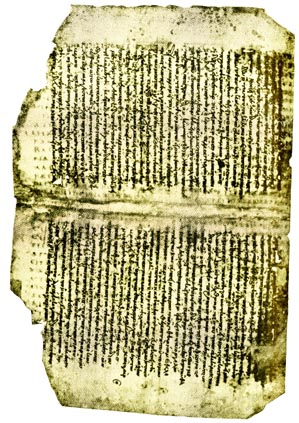
Codex Dublinensis Rescriptus. Dublin, Trinity College K.3.4. Von Soden's e26. Palimpsest, containing portions of Matthew (Matt. 1:17-2:6, 2:13-20, 4:4-13, 5:45-6:15, 7:16-8:6, 10:40-11:18, 12:43-13:11, 13:57-14:19, 15:13-23, 17:9-17, 17:26-18:6, 19:4-12, 21-28, 20:7-21:8, 21:23-30, 22:16-25, 22:37-23:3, 23:15-23, 24:15-25, 25:1-11, 26:21-29, 62-71). The upper writing is a cursive, no earlier than the tenth century, consisting of works of various church fathers, Chrysostom contributing the largest share.
Of the original 120 or so leaves, fourteen double leaves and four half-leaves survive -- in other words, a bit less than 15% of the original text of Matthew.
Dated paleographically to the sixth or possibly fifth century. Written in a large, attractive, and very precise uncial, with the Ammonian Sections but seemingly no Eusebian canons. It has spaces at key points, but very little punctuation, and no breathings or accents. Quotations are indicated with the > symbol. Scrivener notes that it displays unusual forms of many letters, and gives evidence from Abbott that it is relatively free of scribal errors.
Assessments of its text have universally rated it highly; Von Soden
lists it as H (Alexandrian) and the Alands show it as
Category III. The text is
in fact very close to ,
and may be regarded as that manuscript's closest ally. On the Aland scale,
it probably ought in fact to be Category II, except that there is too little
text to be useful for much.
The illustration at right was taken from a very bad photograph, and has been heavily manipulated to try to bring out as much as possible. The colours are false. Note that this is the correct orientation to read the Greek text; the over-writing is at right angles to the lower text.
The manuscript, which by then was already "miserably discoloured" (so Scrivener), was exposed to chemicals by Tregelles in 1853, which yielded little new text but has of course not helped its legibility.
Oxford, Bodleian Library, Auct. T. infr. 2.2 and Saint Petersburg, Russian
National Library Greek 33. Codex Tischendorfianus IV.
Von Soden's e70.
The date of this manuscript is a mystery: It gives a date by
indiction, and also mentions
that (in modern terms) November 27 was a Thursday. Tischendorf calculated that
the only date between 800 and 950 which fits this description is 844, but
Gardthausen calculated that 979 also meets the conditions. Paleographers tend
to date the manuscript to the tenth century. It is rather sloppily written,
with lines ruled badly and irregularly. A later corrector added additional
accents and breathings to those supplied by the original scribe; Scrivener
calls these additions "very careless" and describes the later
scribe as a "scrawler."
G is a copy of the gospels,
with many lacunae in Matthew (lacks Matt. 5:31-6:16,
6:30-7:26, 8:27-9:6,
21:19-22:25) and one in Mark (lacks Mark
3:34-6:21); Luke and John are complete
(there is some damage from damp to the end of Luke, but this does
not render the manuscript illegible).
G was found by Tischendorf
in "an eastern monastery"
and divided into rather odd portions: England has part of Matthew, all that
survives of Mark, all of Luke, and a few leaves of John; Russia has the rest
of Matthew and the larger portion of John.
Assessments of the text of G
have varied a great deal. Scrivener, without being able to examine it fully,
remarked that "Some of its peculiar readings are very notable, and few
uncials of its date deserve more careful study." Von Soden also saw some
value in it, as he classified it as I' (in other words, among the miscellaneous
members of the I group. Most I' members seem in fact to be mostly Byzantine). But
one has to suspect that this classification is actually based on only a single
reading: G is one of the
several manuscripts to exclude Matthew 16:2-3 (others which do so include
B X f13 157 579
and many of the early versions). Recent assessments have been much less kind.
The Alands classify it as Category V (with only
one non-Byzantine reading in 286 test passages, though it also has 12
readings which agree neither with the Byzantine nor the UBS text). Wisse lists
it as Kx in all his test chapters. On the face of it, it would appear
that G, rather than being
an unusually distinguished manuscript for its date, is in fact a perfectly typical
Byzantine manuscript with more than its share of singular errors, the work of
a somewhat inept scribe.
Saint Gall, where it has been as long as it has been known (hence the title Codex Sangallensis). Catalog number: Stiftsbibliothek 48.
Contains the gospels almost complete; it lacks John 19:17-35. The Greek is accompanied by an interlinear Latin translation (designated d). It has been argued that D was originally part of the same volume as Gp; for the arguments for and against this (e.g. their similar appearance and identical size), see the entry on that manuscript.
Usually dated paleographically to the ninth century. (It can hardly be earlier, as reference is made to the (heretical) opinions of Godeschalk at Luke 13:24, John 12:40. These references appear to be in the original hand, and Godeschalk died in 866.) A few sources prefer a tenth century date.
The hand is quite awkward and stiff, resembling Gp in this as in many other ways. The Latin is written above the Greek, and the scribe seems to have been more comfortable with that than with Greek. (There are many reasons for believing this; one of the more noteworthy is his regular confusion of certain Greek letters.) It has been widely suggested that his native language was (Irish) Gaelic.
The form of the manuscript again reminds us of G: It is written in continuous lines, but appears to have been made from a manuscript written in sense lines of some sort; there are enlarged, decorated letters in almost every line. (Though the decorations are very inartistic; Gregory suggests that "[t]he larger letters are rather smeared over than painted with different colours." The enlarged letters do not really correspond with sentences, but rather are quite evenly spaced. Spaces are supplied between words, but these are very inaccurate (more evidence of the scribe's weakness in Greek). There are only a few accents and breathings, not always accurate. Gregory notes that "[t]he titles for the chapters often stand in the middle of the text."
Rettig believed that several scribes worked on the manuscript. This is a difficult question to say the least. The style of the manuscript is very similar throughout. At first glance -- indeed, at any number of glances -- it appears that the scribe is the same throughout. But this is because the hand is so peculiar. The evidence of G indicates that this was more or less the normal style at Saint Gall. So it is possible that there were several scribes -- but the matter really needs to be investigated with modern resources.
For once there is almost universal agreement: D is block-mixed. The usual assessment is that Matthew, Luke, and John are Byzantine, while Mark is Alexandrian. (Indeed, D was the single most important prop in Streeter's argument that manuscripts should be examined first in Mark.) Interestingly, most formal investigations have not precisely confirmed this division into parts; von Soden listed D as H, and the Alands list it as Category III. Even Wisse does not find it to be purely Byzantine in Luke 1; his assessment is that it is Mixed in Luke 1 and Kx in Luke 10 and 20.
It should be noted, however, that both the Aland and von Soden were listing text-types for the gospels as a whole; they are not book-by-book assessments. (The Alands, at least, did not so much as examine John.) An examination of the actual readings of the manuscript shows that conventional wisdom is correct at least in general: D is Byzantine in Matthew, Luke, and John, and is Alexandrian in Mark. We should however add that it is not purely Alexandrian even in Mark; nowhere does it approach the quality of B, or even of L. It is a late Alexandrian/Byzantine mix. It is also my personal impression that D has rather more Alexandrian readings in the early part of Mark, and that the Byzantine component increases somewhat in the final chapters -- but I have not formally verified this.
The interlinear Latin version is sometimes listed as an Old Latin version, and designated d. This is probably at least technically a misnomer; the Latin version was probably prepared after the translation of the Vulgate. But since it has been made to correspond to the text of D, it is not a pure vulgate text. Still, it has no real critical value.
von Soden: e76
Collations:
H. Ch. M. Rettig's edition of 1836 remains the only full-fledged edition.
Fortunately, this edition is said to be highly accurate (Gregory calls it the
best edition of a manuscript prior to Tischendorf).
Sample Plates:
Metzger, The Text of the New Testament (1 page)
Editions which cite:
Cited in all editions since Tischendorf
Other Works:
Tbilisi, Georgia (the former Soviet republic), Inst. rukop. Gr. 28 Known as the Koridethi Codex or Codex Koridethianus (after its earliest known location).
Contains the four gospels nearly complete; lacks Matthew 1:1-9, 1:21-4:4, 4:17-5:4.
The writing of Q is entirely unique -- see the sample letterforms in the article on uncial script; note in particular the delta (well on its way to becoming a Cyrillic letterform), kappa, lambda, mu, and the horizontal shape of chi. The odd letterforms make the manuscript impossible to date; extreme estimates range from the seventh to the tenth century. A late date is all but assured, however, by the generally narrow letterforms and the strong serifs. The most common estimate is the ninth century, and later seems more likely than much earlier.
The scribe of Q was, to put it mildly, not comfortable in Greek; there are strange errors of spelling and grammar on every page. In addition, the scribe does not seem to have been trained to write Greek; he has been accused of drawing rather than writing his letters. Certainly they vary significantly in size and in their relationship to the line. If the scribe knew Greek at all, it was probably as a spoken language.
Gregory and Beermann gave this information about the codex (thanks to Wieland Willker for making this available to me): "In the year 1853 a certain Bartholomeé visited a long abandoned monastery in Kala, a little village in the Caucasian mountains near the Georgian/Russian border... he discovered the MS. The MS rested there probably for several hundred years (Beermann: ca. 1300 - 1869).... Before this time the MS was in a town called Koridethi. This was a village near the Black Sea, near today's Bat'umi in Georgia. There should still be some ruins of a monastery. Notes in the Gospel indicate dates from ca. 965 CE on. At around this time, according to a note, the book has been rebound. The book was there until around 1300 CE."
The most likely explanation is that the scribe was a Georgian, or possibly (as Beermann argued) an Armenian. Not only is the manuscript from the Caucasus, but it has a Georgian inscription on the back cover. In addition, the text appears to have affinity with the Georgian and Armenian versions.
Other than Codex Bezae, perhaps no other manuscript has been so enshrouded in scholarly controversy as the Koridethi Codex. The common statement in the manuals (e.g. Metzger, Kenyon) that it is Byzantine in Matthew, Luke, and John, while having a different text in Mark is simply false; it is based on a misreading (I am tempted to say a perverse misreading) of Streeter. Whatever Q is (and we must defer this question a bit), it is the same throughout the Gospels: It is a mixture of readings of the Byzantine type and something else.
The key question, though, is What is the something else? That the manuscript was interesting was obvious from the very start. When it was first published, it was obvious that some of the non-Byzantine readings were typical of the Alexandrian text, others of the "Western."
It was Kirsopp Lake who first looked at those other readings, and perceived a kinship. It appeared to him that these readings were similar to the non-Byzantine readings of manuscripts such as 1, 13, and 565.
At this point, B. H. Streeter entered the picture. He found, in these readings, a kinship to the text which Origen used while in Cæsarea. He therefore declared this type to be the "Cæsarean" text. Within this type, he included the non-Byzantine readings of a large number of manuscripts, notably (family) 1, (family) 13, 28, 565, and 700 -- but also such things as the purple uncials (N etc.) and family 1424.
But note the key phrase: the non-Byzantine readings of these manuscripts. This proved to be a real sticking point. It has two problems. One is methodological: Streeter assumed that the Textus Receptus is identically equal to the Byzantine text. This is simply not the case; while the TR is Byzantine, it is not a normal Byzantine text. To make matters worse, the chief non-Byzantine influence on the TR is none other than 1. This means that the TR itself has "Cæsarean" readings -- and that, in turn, means that a reading which is purely Byzantine might be classified as "Cæsarean" under Streeter's system.
So does the "Cæsarean" text exist? This is an extremely vexed issue. Streeter described the text as having a mixture of Alexandrian and "Western" readings. Here, again, the description muddies the picture. If the "Cæsarean" type is real, it has only "Cæsarean" readings; it's just that it shares some with the Alexandrian text, and it shares a different set with the "Western" text. (This is to be expected; the majority of variants are binary -- that is, have two and only two readings -- so it follows, if the Alexandrian and "Western" texts disagree, that the "Cæsarean" text will agree with one of them.) But this leads to a problem: If all "Cæsarean" readings are shared with either the Alexandrian or Byzantine or "Western" texts, how do we tell a "Cæsarean" witness from an Alexandrian/Western mixed text? (To add to the uncertainty, we have to decide what is the "Western" text; the fact that Codex Bezae is our only Greek witness, and it in many ways peculiar, makes this a very difficult question.)
There are two partial answers to the question of how to tell a "Cæsarean" from a mixed manuscript: One is that the "Cæsarean" text does have some unique readings. A famous example is Matt. 27:16-17, where Q f1 700* arm geo2 call the criminal released instead of Jesus "Jesus Barabbas," while all other Greek witnesses read simply "Barabbas."
The other is the pattern of agreements. If you create two manuscripts which arbitrarily mix Alexandrian and "Western" readings, they will only agree on half the readings where the two types separate. If two manuscripts have a percentage of agreements which is significantly higher than this, then they are kin.
This was more or less Streeter's argument. But Streeter had a problem: All his "Cæsarean" witnesses were mixed -- they had definite Byzantine overlays. That meant that he could only assess the nature of the underlying text where the manuscripts were non-Byzantine. This was a real difficulty, and made worse by the fact that Streeter (because he used the Textus Receptus to represent the Byzantine text) did not know what the Byzantine text actually read!
Streeter, in examining the non-Byzantine readings of his sundry witnesses, found agreement rates usually in the 70% to 90% range. This is a weak point. Allowing for a 50% inherent agreement rate, and 10% readings where the TR is not Byzantine (making agreements against the TR actually Byzantine), and 10% for coincidental agreement (e.g. harmonizations which could occur independently), and the expected rate of agreement in non-Byzantine readings is on the order of 70%. (I have verified this in testing a number of manuscripts. Unrelated manuscripts usually agree in 60% to 70% of non-Byzantine readings.) Certainly 70% agreement in non-Byzantine readings doesn't prove much.
The result was some decades of confusion. Streeter, by his faulty method, managed to make nearly everything a "Cæsarean" witness, and many scholars followed him. For some decades, there was a hunt for "Cæsarean" witnesses. This more or less culminated in the declaration that P45 was "Cæsarean."
At this point, the whole edifice started to crumble of its own weight. Everything not nailed down had been declared "Cæsarean," often on no stronger basis than the fact that it wasn't in pure agreement with the Textus Receptus. People started wondering about the "Cæsarean" text.
These doubts began to surface as early as the 1940s, but the single strongest blow was not struck until the 1980s, when Larry W. Hurtado published Text-Critical Methodology and the Pre-Caesarean Text: Codex W in the Gospel of Mark. This dissertation attempted to re-examine the entire "Cæsarean" question.
Great claims have been made about the results of this study (not least by its author), but in fact it was a limited work. Still, it accomplished two things: First, it demonstrated (as was already known) that the members of the "Cæsarean" text were not immediate kin, and second, it showed that P45 and W, often treated as the earliest and key "Cæsarean" witnesses, were not "Cæsarean" at all. (That P45 was simply a mixed witness had already been shown by Colwell, who found it to be a freely edited manuscript, but Hurtado generally confirmed Colwell's findings.)
But Hurtado's study had severe flaws of its own. One Hurtado has admitted in internet correspondence: The study did not examine all of the leading "Cæsarean" witnesses. The other is more fundamental: He refuses to acknowledge Streeter's definition of the "Cæsarean" type. Streeter defined the type in terms of non-Byzantine readings. Hurtado dealt with all readings. While he did some classification, it was not Streeter's method of classification. The two are talking past each other. Thus the final word on the "Cæsarean" text remains to be spoken. (As is shown by the fact that many modern scholars firmly believe in the "Cæsarean" text, while others are equally vehement in denying its existence.)
We, unfortunately, cannot prove the matter. The nature of the case, however, is that we must look at the matter using multiple statistical measures -- for that is how the text has been assessed to this point. Those who dismiss the "Cæsarean" text use Hurtado's method of overall agreements. Streeter defined it in terms of non-Byzantine agreements. And those who believe in the type today tend to point to the unique readings of the type, such as the "Jesus Barabbas" reading noted above.
There is, in fact, no fundamental reason why all three methods cannot be used. I have attempted this myself (see the article on Text-Types). The results are interesting: Q and the other "Cæsarean" witnesses do not show unusually high degrees of overall kinship (except that Q and 565 are quite close in Mark). They show high degrees of agreement in non-Byzantine readings -- but not so close a degree of kinship that we can automatically say it is statistically signigicant. In near-singular readings, however, there does appear to be kinship.
Does this settle the matter? No. Since we don't have a mathematical definition of a text-type, we can't just state that the numbers tell us this or that. It appears to me that Streeter's definition is sound, and that Q is the best surviving witness of a small group (Q family 1 family 13 565 700; I am less certain of 28, and I find no others) which have a text-type kinship but have been heavily mixed. Streeter's claim that these are a family (i.e. a group of closely related manuscripts, close than a text-type) is, however, thoroughly untrue. A final answer, however, must await better definitions of our terms.
This has not, of course, kept people from classifying
Q. Von Soden, who
was the first to really examine the manuscript (and who worked before
Streeter) listed it as Ia,
i.e. as a member of the main "Western" group. (We should note that
Streeter took all the Ia
witnesses, save D, and declared them
"Cæsarean.") Wisse classified the manuscript as "mixed"
in Luke (a result which should have told him something about his method, but
didn't. Certainly Q is
mixed -- but we don't want to know if it's mixed; we want to know what elements
compose the mixture! Wisse could detect a weak Group B manuscript, because
manuscripts like B and
gave him a clear Group B profile -- a profile so clear, in fact, that he
could include D in the type! But there is no pure witness to the
"Cæsarean" text; meaning that Wisse could not
have hoped to identify a "Cæsarean"
type if one exists). The Alands, who do not classify by text-types, simply
list Q as
Category II.
von Soden: e050
(and note that the symbol Q
was used for assorted small uncial fragments until Gregory reorganized the
manuscript list)
Note: A true bibliography about Q is impossible, since every work about the "Cæsarean" text is largely about Q. The following list includes only a selection of key works.
Collations:
A Russian facsimile edition of Mark is extremely hard to find. Gustav Beerman and
Caspar René Gregory published the complete text in Die Koridethi
Evangelien Q 038 (1913).
Streeter, however, warns that the secondary collations in this book (comparing
Q against other manuscripts)
are highly inaccurate, at least for the minuscules.
Sample Plates:
Aland & Aland, The Text of the New Testament (1 plate)
Metzger, Manuscripts of the Greek Bible (1 plate)
Editions which cite:
Cited in all editions since Von Soden
Other Works:
Kirsopp Lake and Robert P. Blake, "The Text of the Gospels and the
Koridethi Codex" (Harvard Theological Review, xvi, 1923) is the first
major work on what came to be called the "Cæsarean" text.
B. H. Streeter, The Four Gospels: A Study of Origins, (1924) is the
basic definition of the "Cæsarean" text.
Larry W. Hurtado, Text-Critical Methodology and the Pre-Caesarean Text:
Codex W in the Gospel of Mark is the most recent major study of the
"Cæsarean" text.
Oxford, Bodleian Library, Auct. T. infr. 1.1. Codex Tischendorfianus III. Von Soden's e77. Dated paleographically to the ninth century (although Scrivener allows the bare possibility of the eighth century). It is a curious manuscript, containing only Luke and John in uncials. The gospels of Matthew and Mark were written in minuscules; this half of the manuscript is numbered 566 (von Soden's e77) and located in Saint Petersburg. It has the Eusebian apparatus and a few comments in the margins. It is also noteworthy for having the "Jerusalem Colophon" after all four gospels. Textually, Von Soden listed it as Ir; other members of this group include 262 (which also has the colophon) 545(part) 1187 1555 1573. Wisse lists it as a member of his Group L (though with some "surplus"); this is his equivalent of Soden's Ir. Other members of the group, according to Wisse, include 161 164 166 173(part) 174 199 211 230 262 709 710(part) 899 1187 1205 1301(part) 1502(part) 1555 1573(part) 2465 2585(part) 2586 2725(part). Wisse notes that the group is fairly close to Kx, falling between Group 1216 and Kx. This is confirmed by the Alands, who place it in Category V (Byzantine).
(Xi, 040)Cambridge, University Library, British and Foreign Bible Society MS. 24.
Codex Zacynthius. Von Soden's A1.
Palimpsest, with the upper writing being the lectionary
 299 (thirteenth
century). Presumably originally contained the entire Gospel of Luke with
a catena (probably the oldest catena left to us, and the only one with
both text and commentary in uncial script; nine Fathers are thought to have
been quoted.), but the surviving leaves
contain only Luke 1:1-9, 19-23, 27-28, 30-32, 36-60,
1:77-2:19,
2:21-22, 2:33-3,
3:5-8, 11-20, 4:1-2, 6-20, 32-43,
5:17-36, 6:21-7:6,
7:11-37, 39-47, 8:4-21, 25-35, 43-50,
9:1-28, 32-33, 35,
9:41-10:18, 10:21-40,
11:1-4, 24-33 (86 full leaves and three
partial leaves, originally quite large in size). Dated by W. P. Hatch and the Alands to the
sixth century, but Scrivener argues that the writing in the catena (which
is interwoven with the text, and clearly contemporary, in a hand so small
as to be all but illegible since its erasure) belongs
to the eight century, and other authorities such as Greenlee have tended toward the later
rather than the earlier date (though the absence of accents and breathings
inclines us against too late a date). Textually,
clearly has Alexandrian influence, probably of a late sort (indeed, it appears
to be closer to L than any other manuscript). Wisse lists it as being Kx
in Luke 1 and Group B (Alexandrian) in Luke 10, but this probably does not indicate
block mixture so much as sporadic Byzantine correction. As a catena, Von Soden
does not really indicate a text-type (listing it simply as one of the witnesses to
Titus of Bostra's commentary), but the Alands assign it to
Category III. Perhaps even more interesting
than the text, however, is the system of chapter division, for
uses the unusual scheme of divisions
found in Codex Vaticanus (B), though it also has the usual
system of titloi.
This serves as additional reason to believe that the text is basically Alexandrian.
First edited by Tregelles in 1861, the text has been re-edited as recently as 1957
(by Greenlee), but probably is due for another examination with the most modern technology.
299 (thirteenth
century). Presumably originally contained the entire Gospel of Luke with
a catena (probably the oldest catena left to us, and the only one with
both text and commentary in uncial script; nine Fathers are thought to have
been quoted.), but the surviving leaves
contain only Luke 1:1-9, 19-23, 27-28, 30-32, 36-60,
1:77-2:19,
2:21-22, 2:33-3,
3:5-8, 11-20, 4:1-2, 6-20, 32-43,
5:17-36, 6:21-7:6,
7:11-37, 39-47, 8:4-21, 25-35, 43-50,
9:1-28, 32-33, 35,
9:41-10:18, 10:21-40,
11:1-4, 24-33 (86 full leaves and three
partial leaves, originally quite large in size). Dated by W. P. Hatch and the Alands to the
sixth century, but Scrivener argues that the writing in the catena (which
is interwoven with the text, and clearly contemporary, in a hand so small
as to be all but illegible since its erasure) belongs
to the eight century, and other authorities such as Greenlee have tended toward the later
rather than the earlier date (though the absence of accents and breathings
inclines us against too late a date). Textually,
clearly has Alexandrian influence, probably of a late sort (indeed, it appears
to be closer to L than any other manuscript). Wisse lists it as being Kx
in Luke 1 and Group B (Alexandrian) in Luke 10, but this probably does not indicate
block mixture so much as sporadic Byzantine correction. As a catena, Von Soden
does not really indicate a text-type (listing it simply as one of the witnesses to
Titus of Bostra's commentary), but the Alands assign it to
Category III. Perhaps even more interesting
than the text, however, is the system of chapter division, for
uses the unusual scheme of divisions
found in Codex Vaticanus (B), though it also has the usual
system of titloi.
This serves as additional reason to believe that the text is basically Alexandrian.
First edited by Tregelles in 1861, the text has been re-edited as recently as 1957
(by Greenlee), but probably is due for another examination with the most modern technology.
Saint Petersburg, Russian National Library Greek 34. Codex Petropolitanus.
Formerly owned by Parodus of Smyrna, who was persuaded by Tischendorf to give it
to the Tsar of Russia.
Von Soden's e73.
Dated paleographically to ninth century.
Contains the four gospels with minor lacunae: Matt 3:12-4:18,
19:12-20:3, John 8:6-39.
In addition, Scrivener reports that John 21:22-25 are from
a later hand.
When P
was first discovered, it was observed that it generally agreed
with the Byzantine text, but with certain unusual readings, most of
which agreed with Ke. This kinship was later
formalized by Von Soden, who declared
P (along with K Y
and a number of minuscules such as 265 489 1219 1346) to be members of
his Ika
group. Von Soden felt this group to be a mix of I and K (Byzantine)
texts, with K heavily predominating.
Speedy confirmation of Von Soden's results followed, though the
studies (primarily by Lake, New, and Geerlings) were subject to severe
methodological flaws.
Ik, now
generally known as Family P,
is a genuine and highly recognizable Byzantine subgroup. The most recent work,
that of Wisse, finds Family P
to involve in excess of 100 manuscripts, and breaks it down into two basic
groups (Pa
and Pb) plus
ten sundry clusters. Of these,
Pa is the
largest (65 members) and most significant, containing the two uncials K
and P (both of which
Wisse calls core members of the group) and many minuscules. (The other
Family Pa
uncial, Y, Wisse places in the group
Pa171.) Wisse
also places A in the Pa
group (an opinion first stated by the Lake/Geerlings studies), but admits it
is a diverging member.
The Pa
group is clearly distinct from the "mainstream" Byzantine text of
Kx; in his three chapters of Luke, Wisse notes some three dozen
places where Pa
and Kx diverge (apart from passages where neither formed a fixed
reading), out of 196 passages tested. If one takes the readings noted in
the footnotes of UBS/GNT, the number is somewhat smaller (on the order
of 10-12% of the readings), but still large enough to allow easy recognition
of Famiy Pa
readings. The type is Byzantine, but few Byzantine groups differ so sharply
from the Byzantine norm.
The other interesting point is that it is old. A is not a perfect
member of this group, but it isn't a perfect member of the Byzantine text,
either. Still, A attests to the existence of the Byzantine text in the fifth
century -- and to the existence of Family
P in the same century.
The earliest witnesses to the Kx/Ki/K1
group, by contrast, is E of the eighth century. Although Family
P did not prove to
be the dominant Byzantine group (Kx certainly provides more
manuscripts, and Kr probably does as well), the possibility must
be considered that this is the earliest form of the Byzantine text.
About P itself
there is relatively little to add. The Alands, naturally, list it as
Category V. Interestingly, however, it
has obeli by John 5:4 and 8:3-6 (omitting the earlier portion of the
pericope); we also note that Mark 16:8-20, while present and not marked doubtful,
are not as fully annotated as the rest of the manuscript.
Tirana, Staatsarchiv Nr. 1. Formerly at Berat, hence the name Codex Beratinus. Von Soden's e17. Dated paleographically to fifth (Scrivener) or sixth (Aland) century (Scrivener reports that it "may probably be placed at the end of the fifth century, a little before the Dioscorides (506 A.D.), and before the Codex Rossanensis." No supporting evidence is offered for this.) Purple parchment. Contains portions of the gospels of Matthew and Mark (the loss of Luke and John may be traced to "the Franks of Champagne."). Matt. 1:1-6:3, 7:26-8:7, 18:23-19:3, and Mark 14:62-end are lacking. Textually, Von Soden classified F as Ip, that is, as part of the group which also contains N O S. This assessment has been all but universally accepted, though assessments of the text of the group itself have varied. The Alands place all four manuscripts of the group (the Purple Uncials) in Category V, and it is certain that they are more Byzantine than anything else. Streeter, however, felt that the group had a "Cæsarean" element (for discussion, see the entry on N), which accords with Von Soden's view that they were members of the I text. Samples do not indicate a clear affiliation with any text other than the Byzantine (it should be noted, however, that their defects have kept the profile method from being applied to any of these manuscripts). Of the four, F is generally regarded as being the most unique -- though this may be based primarily on a single reading, the "Western" addition in Matthew 20:28 about seeking what is greater (shared by D a b c d e ff1 ff2 hubmarg ox theo cur harkmarg?). Scrivener describes the writing as follows: " The pages have the kefalaia marked at the top, and the sections and canons in writing of the eighth century at the side. The letters are in silver, very regular, and clearly written. None are in gold, except the title and the first line in St. Mark, and the words Pathr, Ihsous, and some others in the first six folios. There is no ornamentation, but the first letters of the paragraphs are twice as large as the other letters. The letters have no decoration, except a cross in the middle of the initials O's. The writing is continuous in full line without stichometry. Quotations from the Old Testament are marked with a kind of inverted comma. There are no breathings.... Punctuation is made only with the single comma or double comma... or else with a vacant space, or by passing to the next line.... Abbreviations are of the most ancient kind." Edited by P. Batiffol in 1887.
Mount Athos, where it has been as long as it has been known. Catalog number: Athos Laura B' 52
Y originally contained the entire New Testament except the Apocalypse. All of Matthew, as well as Mark 1:1-9:5, have been lost; in addition, the leaf containing Hebrews 8:11-9:19 is lost. The Catholic Epistles have 1 and 2 Peter before James. Y is written on parchment, 1 column per page. It has been furnished with neumes -- one of the oldest manuscripts to have musical markings.
Usually dated paleographically to the eighth/ninth centuries; the latest editions (e.g. NA27) date it to the ninth/tenth centuries.
Y has an unusually mixed text. Aland and Aland list it as Category III in the Gospels, Acts, and Paul, and Category II in the Catholic Epistles. Von Soden lists it as generally Alexandrian.
In fact the situation is even more complicated than this. In Mark the manuscript is distinctly Alexandrian, of the sort of late, mixed cast we see, e.g., in L; like L, it has the double Markan ending. In Luke the manuscript loses almost all traces of Alexandrian influence and becomes predominantly Byzantine. In John the manuscript is mixed -- more Byzantine than anything else, but with significant numbers of Alexandrian readings.
In Acts Y is largely Byzantine.
In Paul Y is more Byzantine than anything else (it is perhaps the earliest substantial witness to that type), although there are certain Alexandrian readings (which seem to bear a certain similarity to those of P). The Alexandrian element seems to be slightly greater in the later books.
In the Catholics Y is again mostly Alexandrian, though with Byzantine influence. The text seems to be of the type found in A 33 81 436.
von Soden: d6
Collations:
Sample Plates:
Metzger, Manuscripts of the Greek Bible (1 page)
Editions which cite:
Cited in all editions since von Soden.
Other Works:
Kirsopp Lake, "Texts from Mount Athos," Studia Biblica et Ecclesiastica V
(Oxford, 1903), pp. 89-185 discusses this manuscript in some depth
Rome, Vatican Library Greek 2066. Soden's a1070; Tischendorf/Scrivener B(r). Contains the Apocalypse complete, along with much other non-Biblical matter (the Biblical text occupies folios 259-278) including homilies of Basil the Great and Gregory of Nyssa. It has been variously dated; Scrivener favours the eighth century, Aland the tenth. The text is of the Byzantine type (so von Soden, who listed it as K, and all experts since); 046 is the earliest manuscript of the main Byzantine group ("a"). The Alands therefore classify it as Category V, though early manuscripts of the Apocalypse are so rare that even a Byzantine uncial deserves special attention. Scrivener describes the writing thus: "the uncials being of a peculiar kind, leaning a little to the right; they hold a sort of middle place between square and oblong characters.... The breathings and accents are primâ manu, and pretty correct..." while the punctuation is fairly well evolved.
Princeton, New Jersey, University Library Med. and Ren. Mss. Garrett 1. Soden's
e95;
original Gregory  .
Contains the Gospels with some mutilations (in Matt. 2-3, 28, Mark 5-6, 8-9, John 12, 14,
and breaking off in John 17). Dated paleographically to the eighth or perhaps the
ninth century. Textually of no great interest; von Soden places it in I' (with
such diverse manuscripts as P Q R
G 064 074 079 090 0106 0116 0130 0131
4 162 251 273 440 472 485 495 660 998 1047 1093 1295 1355 1396 1604 2430),
but the Alands simply list it as
Category V (Byzantine), and Wisse corroborates
this by placing it in Kx throughout.
What interest 047 has is, therefore, derived from its format, for the manuscript
is written in the form of a cross (photo in Aland & Aland and in Metzger,
Manuscripts of the Greek Bible). It is believed that this is the only
continuous-text cruciform manuscript (the lectionaries
233 and
1635 are
also cruciform, and
2135
has some cruciform pages). This format has many drawbacks; it is very wasteful of
writing materials (047 has about 37-38 lines per page; of these typically ten
reach the full width of the page, with about twelve lines above and fifteen below
being slightly less than half the available width. Thus about three-eights of
the usable area of the page is blank), and the format makes it harder to use
the marginalia. These are no doubt among the reason the format is so rarely encountered.
The manuscript has some marginal corrections (including, e.g., one obelizing
John 5:4).
.
Contains the Gospels with some mutilations (in Matt. 2-3, 28, Mark 5-6, 8-9, John 12, 14,
and breaking off in John 17). Dated paleographically to the eighth or perhaps the
ninth century. Textually of no great interest; von Soden places it in I' (with
such diverse manuscripts as P Q R
G 064 074 079 090 0106 0116 0130 0131
4 162 251 273 440 472 485 495 660 998 1047 1093 1295 1355 1396 1604 2430),
but the Alands simply list it as
Category V (Byzantine), and Wisse corroborates
this by placing it in Kx throughout.
What interest 047 has is, therefore, derived from its format, for the manuscript
is written in the form of a cross (photo in Aland & Aland and in Metzger,
Manuscripts of the Greek Bible). It is believed that this is the only
continuous-text cruciform manuscript (the lectionaries
233 and
1635 are
also cruciform, and
2135
has some cruciform pages). This format has many drawbacks; it is very wasteful of
writing materials (047 has about 37-38 lines per page; of these typically ten
reach the full width of the page, with about twelve lines above and fifteen below
being slightly less than half the available width. Thus about three-eights of
the usable area of the page is blank), and the format makes it harder to use
the marginalia. These are no doubt among the reason the format is so rarely encountered.
The manuscript has some marginal corrections (including, e.g., one obelizing
John 5:4).
Rome, Vatican Library Greek 2061. Soden's
a1;
Tischendorf/Scrivener
(ap).
Double palimpsest
(i.e. the biblical text has been overwritten twice), resulting
in a manuscript very difficult to read even on the leaves which survive (and
the leaves which survive are few -- only 21 of what are believed to have been
originally 316 folios. They constitute folios 198-199, 221-222, 229-230,
293-303, 305-308 of Vatican Gr. 2061). These surviving leaves contain
(according to NA27; other sources give slightly different
contents, no doubt based partly on the illegibility of the manuscript)
Acts 26:6-27:4, 28:3-31; James
4:14-5:20; 1 Pet. 1:1-12; 2 Pet.
2:4-8, 2:13-3:15; 1 John
4:6-5:13, 5:17-18,
5:21; 2 John; 3 John; Romans
13:4-15:9; 1 Cor.
2:1-3:11, 3:22, 4:4-6,
5:5-11, 6:3-11,
12:23-15:17, 15:20-27; 2 Cor.
4:7-6:8, 8:9-18,
8:21-10:6; Eph. 5:8-end; Phil.
1:8-23, 2:1-4, 2:6-8; Col.
1:2-2:8, 2:11-14, 22-23,
3:7-8, 3:12-4:18; 1 Th.
1:1, 5-6, 1 Tim.
5:6-6:17, 6:20-21, 2 Tim.
1:4-6, 1:8, 2:2-25; Titus
3:13-end; Philemon; Heb. 11:32-13:4.
The hand is dated paleographically to the fifth century. The manuscript is one
of the very few to be written with three columns per page. Due to the small amount
of text, the manuscript's type has not been clearly identified. The Alands
classify it as Category II, which is probably
about right, but this is on the basis of a mere 44 readings in Paul. Von Soden
did not classify it at all. Observation shows that it is clearly not Byzantine;
the strongest element is probably Alexandrian, though some of the readings
may be "Western."
Paris, National Library Gr. 201. Tischendorf/Scrivener 309e. Dated paleographically to the very end of the uncial period (e.g. Aland lists XI; Scrivener says X-XII). Despite being numbered among the uncials, it is not a true New Testament manuscript, containing rather a commentary with partial text (Chrysostom on Matthew and John, Victor on Mark, Titus of Bostra on Luke). Thus it has not been subjected to textual analysis; Von Soden did not even include it in his catalog (despite listing manuscripts of his A type with even less text), the Alands did not place it in a Category, and Wisse did not profile it. Such minimal evidence as is available indicates, however, that the text is Byzantine. The writing itself, as might be expected of a semi-uncial manuscript variously listed as an uncial and a minuscule, is reported as "very peculiar in its style and beautifully written."
Paris, National Library Coislin Gr. 26. Soden's O7; Tischendorf/Scrivener 16a, 19p. Contains the Acts and Epistles complete. Dated paleographically to the tenth century or even after (Scrivener lists the eleventh century). Commentary manuscript. The commentary is described by Scrivener as "like" that of (the pseudo-)Oecumenius, and of course Soden lists 056 among the Oecumenius manuscripts. The manuscript also includes, according to Scrivener, "a catena of various fathers [and] a life of St. Longinus on two leaves [ix]." Textually, 056 has been little studied; Soden simply listed it as having the Oecumenius text. The Alands correctly place it in Category V (Byzantine). This is elaborated somewhat by Wachtel, who lists it among the manuscripts which are 10-20% non-Byzantine in the Catholic Epistles, pairing it with 0142 (also an Oecumenius manuscript, Soden's O6) and 1066 (another Oecumenius text, though this one exists only in the Acts and Catholic Epistles; Soden's Opr21). That 056 also goes with 0142 in Paul and the Acts is easily demonstrated; indeed, they seem to be closer than we would expect even of Oecumenius texts, and probably go back to a recent common exemplar. In Acts, for instance, the two agree in 184 of 189 test readings (the test readings being of UBS3 for which both exist, including a subsingular reading in Acts 28:14, epi, found in 056 0142 pesh). For comparison, 056 agrees with other Byzantine witnesses as follows: L, 127 of 141; P, 172 of 183; 049, 174 of 190, 1241, 170 of 187. Their five differences in the test readings in Acts are as follows:
| Reading | Text and Supporters of 056 | Text and Supporters of 0142 |
| Acts 5:16 | eis Ierousalhm D E P Byz | Ierousalhm
P74
A B 0189 a gig vg
|
| Acts 10:5 | os
E P 33 Byz
| tina os P74 A B C 81 1739 a vg |
| Acts 11:9 | apekriqh de fwnh ek deuterou ek tou ouranou
P45 P74
A 049 81 1739 gig vg
| apekriqh de moi fwnh ek tou ouranou (singular reading, probably a parablepsis for the reading apekriqh de moi fwnh ek deuterou ek tou ouranou of P Byz) |
| Acts 13:42 | parekaloun ta eqnh eis to P Byz | parekaloun eis to
P74
A C (D) 33 81 1739 al
|
| Acts 27:5 | kathlqomen P74
A B P 33 81 1739
Byz gig
| kathlqomen di emerwn dekapente (singular reading, probably derived from the kathlqomen di dekapente emerwn of 614 1518 2138 2147 2412 a h hark**) |
Thus it would appear that, if anything, 0142 is the ancestor of 056, but examination of the data in Hebrews makes it appear more likely they are derived from a common exemplar, with 0142 perhaps copied slightly earlier. A notable peculiarity of both manuscripts is the use of extra iotas at the end of words. Most of these (perhaps all of them) are instances where an iota would normally be found subscripted, but neither manuscript is consistent in this usage.
Paris, Louvre MS. E 7332. Tischendorf's Tg; Scrivener's T or Tp; Von Soden's a1035. Contains a small fragment of 1 Timothy, 3:15-16, 4:1-3, 6:2-4, 5-8, on two leaves, both damaged. Dated paleographically to the fifth century by most authorities; Scrivener says IV or V. Based on this date, it is very surprising to find the Alands classifying it as Category V -- and even more surprising to find them calling it Category V with singular readings (!). They do not make it easy to check the point, however, as 061 is not cited in the Nestle-Aland edition. Nor did Von Soden classify the manuscript. It must be regarded as a small question mark in the manuscript lists.
Currenty Saint Petersburg, Russian National Library Greek 714 (formerly at Cairo).
Tischendorf's Tk; Scrivener's Tg; Von Soden's
e23.
Contains a small fragment of Matthew, 20:3-32, 22:3-16.
Dated paleographically to
the sixth century by most authorities, though Scrivener allows the possibility of
a seventh century date. He notes that the letters resemble Coptic.
Textually, it is regarded as Alexandrian; Von Soden lists it as H, while
the Alands place it in Category II. A spot
check seems to show a mixed manuscript; taking the readings in Matthew 22 where
NA27 cites 085 explicitly, we find 32 readings of 085, of which
16 agree with ,
16 with B, 19 with D, 22 with L, 17 with
Q,
and 12 with the majority text; a couple of readings are subsingular.
Saint Petersburg, Russian National Library. 095 is MS. Greek 17;
0123 is the first folios of MS. Greek 49.
095 is Von Soden's a1002 and
Tischendorf/Scrivener Ga; 0123 is Von Soden's
a1014 (Gregory 70apl,
possibly Scrivener 72apl, though Scrivener's list gives a ninth century
date and gives the contents incorrectly. Scrivener also lists it as a
palimpsest,
but the Alands simply list it as fragments; one must assume that portions of this
manuscript, so fragmented as to be mistaken for a lectionary, are partly palimpsest).
Scrivener dates it to the seventh century, but the Alands describe it as being
from the eighth. Scrivener reports that the portion known as 095 (his G or
Ga) was "written in thick uncials without
accents, torn from the wooden cover of a Syriac book." 095 contains
Acts 2:45-3:8. The portion known as 0123 consists
of fragments with parts of Acts 2:22-28. It is difficult to assess
the manuscript's type because of
its small size. Von Soden listed 095 as H (Alexandrian), and the Alands
list it as Category III, while Scrivener
admits "a few rare and valuable readings." If we examine the apparatus
of Nestle-Aland27, we find the manuscript cited explicitly only
six times; in these, it agrees with A and C five times (and with P74
in all four readings for which both are extant); with E,
Y, 33, and 1739 four
times; with the Majority Text three times; and with
, B, and D
twice. If such a small sample means anything at all, it would seem to imply
a late Alexandrian witness.
Rome, Vatican Library Greek 2302.
Tischendorf/Scrivener Gb; Von Soden's
a1005.
Palimpsest, six folios
(only five of which had been discovered by
Scrivener's time), consisting of pp. 65-66, 69-72, 75-76,
79-94 of the upper manuscript (a menaeon). The manuscript consists
of Acts 16:30-17:17, 17:27-29, 31-34,
18:8-26.
The date of the manuscript is most uncertain; the date listed in
Scrivener (apparently from Gregory) is fourth century (with a question
mark); the Alands date the manuscript to the ninth century! (In favour of
the later date is the fact that the Alands will have examined the manuscript
using more modern methods.)
0120 is rarely cited; it is not, e.g., a "constant witness"
in the Nestle-Aland text. We are, as a result, largely dependent on the
classifications of others. The Alands list 0120 as
Category III. Von Soden listed it as Ib1,
which (if accurate) is very interesting; Ib1 is the group
containing witnesses such as 206 429 522. In other words, in Acts, this is
a weaker branch of Family 1739. Unfortunately, we must remind ourselves that
Von Soden's results are anything but reliable, particularly for fragments.
Clearly a more thorough examination is called for.
0121: London. British Museum Harley 5613.
0243 (Corinthian portion): Venice. San Marco Library 983 (II 181)
0243 (Hebrews portion): Hamburg. Univ. Libr. Cod. 50 in scrin.
Contents0121 contains 1 Cor. 15:42-end, 2 Cor. 1:1-15, 10:13-12:5 0243 contains 1 Cor. 13:4-end and all of 2 Cor.; Heb. 1:2-4:3, 12:20-end. Date/ScribeBoth manuscripts generally dated to the tenth century (so, e.g. NA27). G. Zuntz, however (The Text of the Epistles, London, 1953, pp. 74, 286-287) states that 0121 "is by no means an 'uncial': its letters are the kind of majuscule which scribes of the tenth and later centuries often used to distinguish marginal scholia from the text. In M [=0121] these majuscules contain a significant admixture of minuscule forms.... I should ascribe M to the twelfth century." (See facsimile at right.) Both are written in red ink on parchment, two columns per page. |
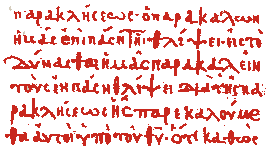
Facsimile of 2 Cor. 1:3-5 in 0121 (after Scrivener). Colors are exaggerated and manuscript is enlarged. The unaccented text reads PARAKLHSEWS . O PARAKALWN HMAS EPI PASH THI QLIYEI . EIS TO DUNASQAI HMAS PARAKALEIN TOUS EN PASH QLIYEI DIA THS PA RAKLHSEWS HS PAREKALOUME QA AUTOI UPO TOU QU. OTI KAQWS |
Before we can describe these manuscripts, we must describe their recent history. When first two portions of the manuscript (what we now call 0121 and the Hebrews portion of 0243) were discovered, it was observed that both were of about the same date, that both were in red ink, that they had similar texts, and that both were in two columns on parchment. It was naturally assumed that they were the same. In Tischendorf, the fragments were referred to as M. In the Gregory catalog, this became 0121. Then Birdsall observed that the two were in distinct hands. So the Corinthian portion became 0121a and the Hebrews portion 0121b. They were cited in this way in NA26.
Of course, multiple scribes do write manuscripts. This was not really proof that they were originally separate. But more was forthcoming.
At about the same time Birdsall discovered that the two were by different scribes, the larger (Corinthian) portion of 0243 came to light. Some time later, it was realized that this was part of the same manuscript as 0121b. This finally proved that 0121a and 0121b were separate (since 0121a and 0243 overlap). So 0121b was renumbered 0243 and 0121a became 0121. This is how things are cited in NA27
If this is confusing, maybe this table will help:
| Contents | Tischendorf Symbol | Gregory Symbol | NA26 symbol | NA27 symbol |
| 1 Cor. 15:42-end, 2 Cor. 1:1-15, 10:13-12:5 | M | 0121 | 0121a | 0121 |
| Heb. 1:2-4:3, 12:20-end | M | 0121 | 0121b | 0243 |
| 1 Cor. 13:4-end and all of 2 Cor. | - | - | 0243 | 0243 |
In all this shuffling, one thing remains certain: Both manuscripts are closely affiliated with 1739. 0243 is a probably a first cousin (perhaps even a sister); 0121 is a cousin or descendant.
Several striking examples of agreements between 0243 and 1739 may be cited. Perhaps the most noteworthy is Hebrews 2:9, where 0243, 1739*, and perhaps 424**, alone among Greek manuscripts, read CWRIS QEOU instead of the majority reading CARITI QEOU.
The reader who wishes further details, including a comparison of the readings of 0121 and 1739, is referred to the entry on 1739 and family 1739.
Von Soden lists 0121 as H. Aland and Aland list 0121a as Category III and the Corinthian portion of 0243 as Category II (its sister 1739 is, however, a Category I). 0121b is still in their list, and is Category III (!).
For 0121: von Soden: a1031. Tischendorf: Mp
Bibliography
J.N. Birdsall, A Study of MS. 1739 and its Relationship to MSS.
6, 424, 1908, and M (unpublished Ph.D. dissertation, 1959)
Collations:
A collation of the Hebrews portion of
0243 is available here.
Sample Plates:
(I know of none in the standard editions; Scrivener has a facsimile)
Editions which cite:
Cited in NA26 as 0121a, 0121b, and 0243.
Cited in UBS3 as 0121a, 0121b, and 0243.
Cited in NA27 as 0121 and 0243.
Cited in UBS4 as 0121 and 0243.
Von Soden, Merk, and Bover cite the "M" portions.
Other Works:
Saint Petersburg, Russian Pubic Library Greek 32. Soden's a1030; Tischendorf/Scrivener N(p); Hort's Od. Two folios containing small fragments of Paul: Gal. 5:12-6:4, Heb. 5:8-6:10. Dated paleographically to the ninth century. Textually, the Alands have assigned it to Category III, but Von Soden listed it as K (purely Byzantine), and the latter assessment seems to be correct. An examination of its readings in Galatians reveals the following departures from the Byzantine text:
| Verse | Byzantine reading | 0122(*) reads | comment |
| 5:12 | anastatountes | 0122* anastantountes | singular; probable copying error at some stage |
| 5:14 | eauton | 0122* seauton | Byzantine text divided |
| 5:17 | a an | 0122* a ean | also found in A pc
|
| 5:22 | de | 0122c omits | singular reading |
| 5:23 | egkrateia | 0122c egkrateeia upomonh | singular reading |
| 5:24 | Ihsou Cristou | 01221 Cristou Ihsou | 0122*, 01222 with the Byzantine text |
| 6:1 | prolhfqh | 0122c proslhfqh | singular reading |
| 6:3 | ti | 0122c omits | subsingular, found also in B* 075c |
It will thus be observed that all deviations from the Byzantine text are relatively trivial and generally poorly supported. I have not examined the portion in Hebrews in detail, but the Nestle apparatus makes it appear that 0122 is equally Byzantine there. It will be observed that the manuscript has been fairly heavily corrected (observe the double correction in Gal. 5:24), but the corrections have no more significance than the original text; indeed, in this admittedly tiny sample they seem simply to be more idiosyncratic.
New Haven, Yale University Library P. Dura 10. 0212
is not technically a New Testament manuscript; rather, it
is a fragment of a gospel harmony. It was discovered in
the ruins of Dura Europus in 1933. Since Dura was a
Roman fortress town sacked by Shapur I of Persia in
256/7 C.E., the assumption is that the
manuscript was written in the first half of the third
century, though an earlier date cannot be excluded.
The fragment was found in an earth embankment believed
to have been built for the final defense of the town. It
was fairly close to a small Christian chapel, but far
enough away that it may have come from some other source.
Physically, the surviving fragment (usually regarded as
only a portion of a leaf, though the edges are sharp and
some seem to have been cut with a knife) measures 10.5 cm by
9.5 cm. It is written on only one side, and may well have
come from a scroll. (The most recent study of the manuscript,
D. C. Parker, D. G. K. Taylor,
M. S. Goodacre, "The Dura-Europos
Gospel Harmony," published in Taylor, Studies in the Early
Text of the Gospels and Acts, concludes that it is
definitely a scroll, not a codex, based on observations of
holes along one edge which seemingly correspond to
stitches.) The surviving column
originally contained about 30-35 letters per line (with
the first five or more letters lost, and with additional
damage to certain of the lines). Portions of fourteen
lines survive. As noted, it is a gospel harmony, containing
phrases seemingly from Matt. 27:56-57, Mark 15:40, 42,
Luke 23:49, 50, 51, John 19:38. (So Kraeling, who
first edited the manuscript; for this transcription,
see e.g. Metzger, Manuscripts of the Greek Bible, p.
66. The reconstruction of Parker, Taylor, and Goodacre,
found in the article cited above, differs in only a few
particulars, though some of the differences are significant).
The manuscript has some unusual orthographic features, including
the Nominum Sacrum
sta --
an abbreviation found nowhere else, with uncertain meaning.
0212 has generally been regarded as a fragment of Tatian's
Diatessaron,
though the small size of the fragment meant that this was
never certain. Parker, Taylor, and Goodacre, upon
detailed examination and comparison with recent studies,
are convinced that the fragment is not Tatianic, but
is a fragment of a separate Gospel harmony (perhaps
devoted solely to the passion narrative), compiled in
Greek from Greek sources.
Since 0212 is not a New Testament fragment, the Alands
did not analyse it, and it is too recent to have been
analysed by Von Soden. It appears to contain a unique
reading in Luke 23:49, referring to the wives of Jesus's
disciples. This text is, however, only partly legible.
See: 0121 and 0243