Age, species and the gender of the specific animal should also be part of your selection process.
If it is not your intention to breed chameleons, it is probably wise to select a male. Female chameleons are more delicate and have special needs, due to the large numbers of eggs many captive animals produce. Females need more calcium supplementation than do males. For these reasons, a female chameleon should not be considered as a first chameleon.
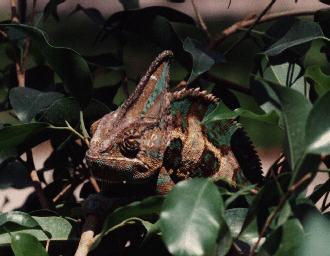 Chamaeleo calyptratus (Veiled Chameleons) are large, colorful, and hardy chameleons that are ideal for first-time enthusiasts. Because of their hardiness, captive bred animals are readily available. Care should be taken, however, to ensure that animals are purchased from respected breeders, as inbreeding with this species has become quite a wide-spread problem.
The largest drawback to keeping C. calyptratus is their size. Large males can approach or exceed 2-feet in total length. As a result these animals need very large enclosures.
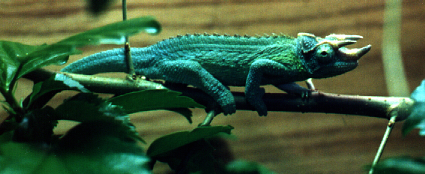 Chamaeleo jacksonii (Jackson's Chameleons) are highly unusual animals. Males sport 3 horns, making them resemble a small triceritops. These are small to medium sized chameleons which are available as captive bred stock. They are not as hardy as C. calyptratus. But their size and temperature requirements make them easier for some first-time chameleon keepers.